


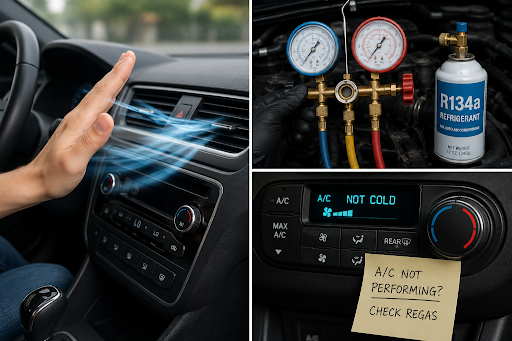
If your car’s air conditioning is blowing cool air instead of properly cold air, the refrigerant level may be lower than it should be. AC systems can lose refrigerant gradually, so the problem often develops slowly rather than appearing as a sudden failure. You may first notice that the cabin takes longer to cool, the system struggles on hot days or the air no longer feels as cold as it used to.
Your car’s air conditioning system relies on refrigerant to absorb heat from inside the cabin and release it outside the vehicle. When the refrigerant level falls, the system cannot transfer heat as effectively. Other faults can cause similar symptoms, however, so a professional check is useful before assuming that a regas is all the car needs.
This guide explains six common warning signs that your AC may need attention, what can cause poor cooling, what happens during a professional regas and when a regas may not be enough to fix the problem.
If your car’s AC is no longer cooling as effectively as it used to, booking a car air con regas in Aldershot can help restore the correct refrigerant level and cooling performance. A proper service should also check whether a leak or another fault is affecting the system.
How Car Air Conditioning Actually Works
Before covering the warning signs, it is worth understanding what the system is doing and why refrigerant matters so much to its performance.
A car air conditioning system works by circulating refrigerant gas through a closed loop of components. The compressor pressurises the refrigerant and pushes it through the condenser at the front of the car, where heat is expelled. The cooled refrigerant then passes through the evaporator inside the cabin, where it absorbs heat from the air being drawn through the system. That cooled air is then blown into the cabin through the vents.
The refrigerant is the medium that carries heat out of the cabin. Without an adequate quantity of it at the correct pressure, the system cannot complete this heat exchange cycle effectively. The compressor runs, the fans run, but the air reaching you has not been adequately cooled.
Refrigerant does not burn off or get consumed in the way engine oil does. However, even a sealed system loses a small amount of refrigerant each year through microscopic permeation of seals and connections. Most manufacturers recommend a full regas every two years to account for this natural depletion, regardless of whether obvious symptoms have appeared. If it has been longer than two years since your last regas, or if you cannot recall having one at all, the interval has almost certainly passed.
| Refrigerant | Commonly found in | Typical service interval* |
| R134a | Many older vehicles | Around 2 years |
| R1234yf | Many newer vehicles | Around 2-3 years |
*Intervals vary by vehicle. Check the manufacturer’s specification or the AC system label before servicing.
The 6 Warning Signs Your AC Needs a Regas
Sign 1: The Air from the Vents Is Cool Rather Than Cold
This is the most common early warning sign and the one most drivers dismiss for too long. The system appears to be working: air is coming through the vents, the compressor is running, the button is lit up on the dashboard. But the air does not feel genuinely cold. It feels cool, or perhaps mildly refreshing on a cooler day, and almost useless on a warm one.
The distinction matters because many drivers assume that if air conditioning is producing any cool air at all, the system is functioning adequately. In reality, reduced cooling is almost always an early indicator of falling refrigerant levels. The system is still working, but it does not have enough refrigerant to complete the heat exchange cycle efficiently. The warmer the outside temperature, the more obvious this becomes.
If your air conditioning used to produce noticeably cold air and no longer does, the refrigerant level is the first thing to investigate. In most cases, a regas is all that is needed to return the system to its original performance.
Sign 2: The Cabin Takes Much Longer to Cool Down
Think back to how your air conditioning performed a summer or two ago. On a hot day, how long did it take the cabin to become comfortably cool? If the answer used to be a couple of minutes and is now closer to ten or fifteen, that progressive deterioration in cooling speed is a clear sign of reduced refrigerant.
A system with adequate refrigerant can cool a cabin quickly because it is shifting heat efficiently through the full cycle. A system running low on refrigerant does the same job more slowly because each cycle is moving less heat. The cabin cools eventually, but the rate at which it does so drops noticeably.
This symptom is particularly easy to overlook because it develops gradually. Drivers adjust their expectations over months and forget how the system used to perform. A useful reference point is to ask whether the system still cools the car in a time that feels reasonable for a warm day, or whether you have started to accept that it takes significantly longer than it should.
Sign 3: Unusual Noises When the AC Is Switched On
A healthy air conditioning system engages with a soft, audible click when you press the button. This click is the compressor clutch engaging, connecting the compressor to the engine belt. The engine note may change very slightly as the load increases, but beyond that, the system should operate quietly in the background.
Unusual noises are a warning that something is wrong. The specific sounds to listen for include:
- A rattling or chattering noise from the compressor when the AC is first engaged
- A hissing or bubbling sound from behind the dashboard or near the engine bay
- A grinding or screeching noise that accompanies or follows the click of the clutch engaging
- Rapid clicking as the compressor engages and disengages repeatedly in quick succession
The hissing or bubbling sound is particularly associated with low refrigerant levels, as refrigerant moving through the system with insufficient pressure can produce these noises. The rapid cycling sound, where the compressor clicks on and off repeatedly within seconds, occurs because the system’s low-pressure safety switch is cutting the compressor out to protect it from damage. This safety function exists precisely because running a compressor without adequate refrigerant, which also carries the lubricating oil the compressor needs, causes rapid internal wear. Continued use in this state risks compressor failure.
Sign 4: Unpleasant or Musty Smells from the Vents
A properly functioning air conditioning system should produce clean, odourless air. If switching the AC on produces a musty, damp, or faintly mouldy smell, the system needs attention.
The smell itself is caused by bacterial and mould growth on the evaporator, which sits inside the dashboard where it handles moist air continuously. In a well-maintained system, the evaporator stays sufficiently cold and dry to inhibit this growth. In a system running low on refrigerant, the evaporator does not reach the correct temperature, which creates a warm and persistently damp environment where bacteria and mould thrive.
The smell is an unpleasant experience for everyone in the car, but it is also a health consideration. Air conditioning systems filter the air being circulated through the cabin, and a contaminated evaporator is actively distributing bacteria and mould spores through that air. Families with young children, anyone with allergies, and hay fever sufferers in particular will notice the difference between clean AC air and contaminated AC air during the summer months around Aldershot and across Hampshire.
A regas and an AC system clean addressing the evaporator will resolve this combination of issues in most cases.
Sign 5: The Windscreen Takes Longer to Demist in Winter
This is the warning sign that catches most drivers completely off guard, because they do not associate a summer-focused system with winter performance. The reality is that your air conditioning system runs every time you press the demist button, regardless of season. The AC dehumidifies the air inside the cabin, which is what removes condensation from the windscreen far more quickly than heat alone.
If you noticed during the past winter that your windscreen was taking noticeably longer to clear than it used to, or that you had to increase the temperature or fan speed significantly to achieve what used to happen automatically, the AC system was underperforming in demist mode for the same reason it underperforms in cooling mode: low refrigerant.
This is one of the earlier signs of depletion, because the system is working under less demand in demist mode than in full summer cooling mode, and the performance gap only becomes truly obvious when conditions are extreme. Drivers who noticed slow demisting last winter and have not yet acted are running into summer with a system that is already known to be below specification.
| Warning Sign | What It Indicates | Urgency |
| Cool rather than cold air | Refrigerant below optimum level | Book soon |
| Slow cabin cooling | Reduced heat exchange capacity | Book soon |
| Hissing or bubbling noises | Refrigerant moving at low pressure | Book promptly |
| Rapid compressor cycling | Low pressure safety switch activating | Book urgently |
| Grinding on clutch engagement | Compressor lubrication risk | Book urgently |
| Musty smell from vents | Bacterial growth on evaporator | Book promptly |
| Slow winter demisting | AC running below specification | Book before summer |
| No cold air at all | Severely depleted or no refrigerant | Book immediately |
Sign 6: The AC Makes No Difference at All When Switched On
If pressing the air conditioning button produces no discernible effect on the temperature of the air from the vents, the system is either critically low on refrigerant or has a fault beyond depletion alone.
When refrigerant levels fall below a certain threshold, the low-pressure safety switch prevents the compressor clutch from engaging at all, because running the compressor without adequate refrigerant would destroy it quickly. The practical result is an air conditioning button that lights up, a fan that blows air, but no cooling whatsoever, because the compressor is not running.
At this stage, a regas alone may resolve the issue if the only problem is depletion. However, if the refrigerant has dropped this significantly without a regas being overdue, a leak somewhere in the system is likely. A reputable regas service will perform a vacuum test before adding refrigerant, which checks whether the system can hold pressure. If it cannot, the leak needs to be identified and repaired before a regas will be effective. Adding refrigerant to a leaking system provides only temporary results and does not address the underlying fault.
What Actually Happens During a Regas
Understanding what the process involves helps drivers assess whether a quoted service is comprehensive or cursory.
A proper air conditioning regas is not simply a matter of topping up the refrigerant. A thorough service follows a defined sequence:
- The technician connects specialist equipment to the AC service ports and checks the current system pressure to assess the degree of depletion
- All existing refrigerant is recovered from the system using the regas machine, not vented to atmosphere, which would be illegal under UK F-Gas regulations
- A vacuum is applied to the empty system and held for a defined period to check for leaks. A system that cannot hold a vacuum has a leak that must be repaired before the regas proceeds
- New refrigerant, along with fresh lubricating oil for the compressor, is charged into the system to the manufacturer’s specified weight in grams
- System performance is checked after recharging to confirm temperatures and pressures are within normal operating range
A regas that skips the vacuum test is not a complete service. Refrigerant added to a leaking system will simply escape again, sometimes within weeks, leaving the driver paying for a service that provides only temporary improvement.
When a Regas Is Not Enough
A regas resolves the vast majority of underperforming AC complaints because refrigerant depletion is the most common cause of reduced cooling. However, there are situations where the underlying issue is more significant and a regas alone will not deliver a lasting fix.
A compressor that has failed mechanically will not circulate refrigerant regardless of how much is in the system. A blocked or damaged condenser at the front of the car will prevent the system from dissipating heat effectively. An electrical fault in the compressor clutch circuit, a faulty pressure switch, or a problem with the climate control module can all prevent the system from operating correctly without any refrigerant-related cause.
The diagnostic process during a proper regas service will typically identify whether the system has a refrigerant depletion. If the vacuum test fails, a leak investigation is needed. If the system holds a vacuum but performance remains poor after recharging, a compressor or condenser check is the logical next step.
If the system holds a vacuum but the AC still performs poorly after recharging, the technicians at Ash Road Service Centre can investigate whether a compressor, condenser, electrical or pressure-related fault is affecting the system.
Why Spring Is the Right Time to Act
The timing of an AC regas matters more than many drivers appreciate. Spring is consistently the best time to address air conditioning maintenance, for several reasons.
Garages are significantly busier from June onwards as the first warm weeks of the year prompt every driver who ignored the warning signs to book in simultaneously. Booking in April or May avoids the wait and ensures your system is fully operational before it is actually needed.
A spring regas also gives technicians the opportunity to identify any developing faults, a slow leak, a compressor showing early signs of wear, or an evaporator that needs cleaning, while there is still time to address them without leaving you without cooling during a heatwave.
Does AC Performance Affect the MOT?
The air conditioning system itself is not directly assessed during an MOT test. However, certain issues that develop from a neglected AC system can indirectly affect the test result. A seized compressor that has been running without adequate lubrication can sometimes produce engine management codes or affect belt-driven systems in ways that are picked up during the test. A climate control fault that triggers a dashboard warning light will result in an automatic major defect.
More practically, an MOT also checks the windscreen demisting system for effectiveness. A vehicle whose front windscreen cannot be demisted to a clear standard within a reasonable time will fail the inspection. Drivers who noticed slow demisting last winter and have a test approaching should address the AC system before the test date.
A Simple Pre-Summer AC Check You Can Do Yourself
Before booking a regas, a quick roadside assessment of your own AC system takes less than five minutes and gives you useful information to share with a technician.
- Start the engine and allow it to reach normal operating temperature
- Switch the air conditioning on and set it to maximum cooling with the fan at full speed
- Listen for the click of the compressor clutch engaging within a few seconds of pressing the button. If there is no click and no change in engine note, the compressor is not engaging
- Hold your hand in front of a vent and note the temperature. On a mild day, air from a healthy system should feel noticeably cold within thirty seconds, not just cool
- Listen for any hissing, bubbling, rattling, or rapid clicking sounds from the engine bay or dashboard area
- Note whether a musty or unpleasant smell appears when the AC is running
- Check when the system was last regassed. If it was more than two years ago, a service is due regardless of any symptoms
Any of the above checks that reveal a concern is worth mentioning specifically when booking your appointment. The more detail a technician has about how the system is behaving, the faster and more accurately they can assess what is needed.
If your checks reveal poor cooling, unusual noises or another persistent problem, it is worth arranging a professional inspection before summer arrives. You can read Ash Road Service Centre reviews on Google before booking and check the garage information before your visit.
Conclusion
Your car’s air conditioning system is not a fit-and-forget component. Refrigerant depletes naturally over time, and the performance loss that accompanies that depletion tends to creep up so gradually that drivers adjust to a lower standard of cooling without realising how far it has slipped.
The six warning signs covered in this guide, reduced cooling, slow cabin temperature drop, unusual noises, unpleasant smells, poor winter demisting, and complete loss of cooling, all point in the same direction: the system needs attention. The solution in most cases is straightforward. A professional regas restores refrigerant to the correct level, lubricates the compressor, and verifies that the system is leak-free, returning performance to the standard the car was built to deliver.
The best time to act is before the first heatwave of summer makes the problem impossible to ignore. A booking in spring costs the same as one in July, but comes without the wait, without the discomfort of a sweltering cabin while you queue for an appointment, and with the satisfaction of knowing your car is ready for whatever the British summer decides to offer.
Frequently Asked Questions
How often does a car AC system need regassing in the UK?
Most manufacturers recommend a regas every two years for vehicles using R134a refrigerant, which covers most UK cars registered before 2017. Newer vehicles using R1234yf refrigerant can sometimes extend this to three years, but two years remains the safest general guideline for all vehicles.
Can I top up the refrigerant myself with a DIY kit?
DIY regas kits are available but are not a substitute for a professional service. They cannot recover old refrigerant, perform a vacuum test for leaks, or charge the system to the correct weight in grams. A system with a leak will simply lose the DIY-added refrigerant again quickly. Under UK F-Gas regulations, refrigerant cannot be legally vented to atmosphere, which rules out a proper recovery process without specialist equipment.
Will a regas fix a completely non-functional AC system?
A regas resolves the issue in the majority of cases where the cause is refrigerant depletion. If the system has a mechanical fault such as a failed compressor, a damaged condenser, or an electrical fault, a regas will not resolve those issues. A professional service includes a vacuum test and performance check that helps identify whether a fault beyond depletion is present.
Does the air conditioning system use more fuel?
Yes, but modestly. Running the AC places additional load on the engine, which increases fuel consumption by a small percentage. However, the difference is relatively minor in normal driving conditions, and the compressor only operates intermittently rather than continuously.
Is it normal for the AC to smell when first switched on after winter?
A brief, faint smell when the AC is first switched on after a long period of non-use is not unusual and often dissipates quickly. A persistent musty or mouldy smell that continues whenever the AC is running indicates bacterial growth on the evaporator that needs to be addressed with a proper AC system clean.
Can I use the AC in winter and does it help with demisting?
Yes, and it is actively recommended. The air conditioning system dehumidifies the cabin air regardless of the temperature setting, which makes it significantly more effective at clearing a misted windscreen than heat alone. Running the AC periodically throughout winter also keeps the seals and compressor lubricated, reducing the risk of system faults developing through extended non-use.