


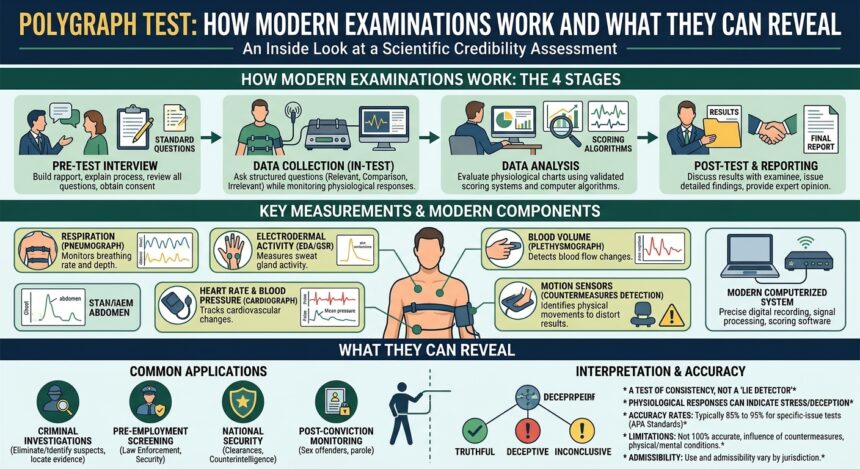
Polygraph Test: How Modern Examinations Work and What They Can Reveal
A polygraph test is a structured psychophysiological examination designed to evaluate physiological responses while a person answers carefully prepared questions. Although often called a “lie detector,” a polygraph does not directly detect lies. Instead, it records changes in breathing, cardiovascular activity, electrodermal activity and movement, which are then evaluated by a trained examiner using an established testing technique.
For individuals, families, businesses and investigators seeking clarification about a disputed event, a professionally conducted examination can provide another source of information to consider alongside interviews, documents and other evidence. Understanding how the process works is important because a responsible examination should be approached as an investigative tool rather than an infallible machine that automatically determines whether someone is telling the truth.
What Happens During a Polygraph Test?
A professional examination normally involves several stages rather than simply attaching sensors and asking questions. The process begins with a detailed discussion between the examiner and the examinee.
1. The Pre-Test Interview
The examiner first explains the procedure, discusses the purpose of the examination and reviews the questions that will be asked. This stage is particularly important because ambiguous or poorly worded questions can make physiological responses difficult to interpret.
The examinee should understand:
- Why the examination is being conducted
- What subjects will be discussed
- How the questions are structured
- What the sensors measure
- How the examination will be evaluated
- What type of result may be reported
Recognised professional standards emphasise informed consent and reviewing the test questions before data collection begins.
2. Physiological Data Collection
During the testing phase, sensors are attached to the examinee. Depending on the equipment and methodology, the system can monitor several physiological channels, including respiration, cardiovascular activity, electrodermal responses and movement.
The examiner then presents the agreed questions in a structured sequence. The machine records physiological changes while the person answers.
3. Analysis and Professional Opinion
The recorded data is subsequently evaluated using the relevant scoring or analysis method. The examiner considers patterns across the physiological channels rather than treating a single increase in heart rate or perspiration as proof of deception.
This distinction matters. Nervousness, fear, embarrassment, surprise and other emotional reactions can also produce physiological changes. The American Psychological Association notes that the same physiological responses associated with deception can occur when someone is nervous even when they are not lying.
Why Question Design Matters
One of the most important parts of an examination is the wording and structure of the questions. A question should relate clearly to the issue being examined and should not unnecessarily combine several unrelated allegations.
For example, instead of asking a complicated question covering several events, an examiner may focus on a specific allegation or incident. This allows the resulting physiological responses to be interpreted in relation to a defined subject.
A well-organised examination generally benefits from:
- A clearly defined testing objective.
- Questions reviewed before the examination.
- Consistent testing procedures.
- Appropriate instrumentation.
- A qualified and impartial examiner.
- A structured analysis method.
- A written explanation of the result and its limitations.
Where Can Polygraph Testing Be Useful?
Polygraph examinations may be considered in a variety of situations, depending on local law, professional standards and the circumstances of the case.
| Situation | Potential purpose |
|---|---|
| Personal disputes | Clarifying a specific allegation |
| Relationship concerns | Addressing questions about a defined event |
| Workplace investigations | Supporting an internal investigation |
| Theft or misconduct inquiries | Examining a specific allegation |
| Criminal investigations | Providing an additional investigative lead |
| Screening | Assessing defined areas of concern |
| Civil or family matters | Providing additional information for consideration |
The British Polygraph Society describes applications including criminal investigations, corporate investigations, civil and family matters, pre-employment screening and private contexts, while noting that applicable laws and circumstances must be considered.
How Accurate Is a Polygraph Test?
Accuracy is one of the most frequently misunderstood aspects of polygraph testing. There is no single accuracy figure that applies to every examination. Results can vary according to the testing technique, question format, circumstances, examiner training and whether the examination concerns a specific incident or broader screening.
Recent British Polygraph Society guidance reports that validated single-issue techniques can reach published accuracy levels around or above 90% under specified conditions, while also emphasising that polygraph results are probabilistic rather than absolute.
At the same time, independent scientific organisations have expressed significant reservations about the reliability of polygraph testing. The American Psychological Association states that research does not support treating polygraphs as a completely reliable or accurate method of detecting deception in most forensic, legal or employment situations.
This difference in perspectives highlights an important principle: a polygraph result should be interpreted in context and should not automatically be treated as proof of guilt or innocence.
What Can Affect the Examination?
Several factors may influence physiological responses during testing. These include emotional reactions, the relevance of the questions, the testing environment, physical movement and the individual’s understanding of what is being asked.
A professional examiner therefore needs to distinguish reactions that may be relevant to the examination from reactions that could have another explanation.
An inconclusive outcome is also possible. Rather than forcing every examination into a simple “truth” or “lie” category, responsible testing recognises that some results cannot be interpreted with sufficient confidence.
Choosing a Professional Polygraph Service
Anyone considering a polygraph examination should look beyond the equipment itself. The examiner’s experience, methodology, question design and professional standards are equally important.
Before arranging an examination, consider asking:
- What qualifications and professional training does the examiner have?
- Which testing methodology will be used?
- How are questions prepared?
- How is the data analysed?
- Is informed consent obtained?
- Are fees independent of the eventual result?
- What documentation is provided afterward?
- How are confidentiality and personal information handled?
A professional service should explain the process clearly rather than promising an impossible guarantee of a particular result.
Get Clearer Information Before Making an Important Decision
If you are considering a polygraph test because you need clarification about a specific allegation, choosing an experienced professional can make the process more structured, transparent and useful. Before booking, review the available services, examination procedures, examiner credentials and contact information carefully so you know exactly what to expect.
Ready to explore your options? Visit the website to learn more about available polygraph services, understand the examination process and contact the team directly for further information. A professional consultation can help you determine whether a polygraph examination is appropriate for your particular circumstances.