


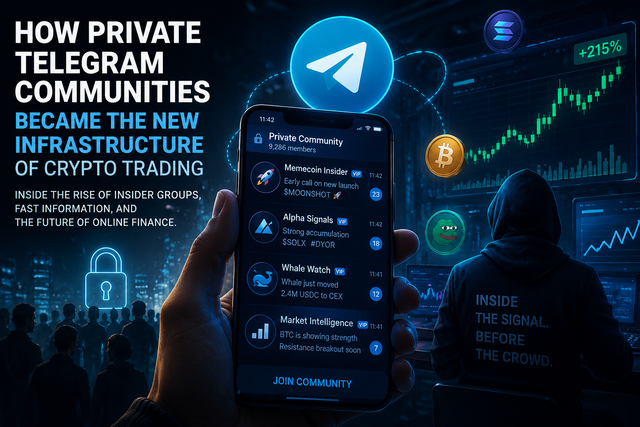
How Private Telegram Communities Became the New Infrastructure of Crypto Trading
Over the past few years, messaging apps have quietly evolved from simple communication tools into the operational backbone of the cryptocurrency market. Nowhere is this shift more visible than on Telegram, where fast-moving traders now rely on private communities such as a Memecoin Insider Telegram Group to receive early information long before it reaches the public. What began as casual group chats has grown into a structured layer of the digital-asset economy, shaping how information travels, how trades are timed, and how communities form around emerging tokens.
This article looks at why Telegram became so central to crypto culture, how private communities differ from public channels, and what the rise of insider-style groups tells us about the wider direction of online finance.
Why Telegram Became the Default Home for Crypto
Telegram’s dominance in the crypto world is not accidental. The platform offers a combination of features that traditional social networks and financial forums simply do not: near-instant message delivery, support for very large groups, lightweight bots that can automate tasks, and a culture that values speed and privacy over algorithmic feeds.
For an industry that operates twenty-four hours a day across every time zone, these qualities matter. A price move or a token launch can unfold in minutes, and traders need a channel where information reaches them without the delay of a curated feed. Telegram delivers messages in real time to everyone in a group at once, which makes it uniquely suited to markets that never close.
The result is an ecosystem where millions of users now treat Telegram not as a side channel but as their primary source of market awareness.
Public Channels Versus Private Communities
Not all crypto communities on Telegram work the same way. Broadly, they fall into two categories, and understanding the difference explains a great deal about how information flows through the market.
Public channels operate as broadcast rooms. A single administrator posts updates, and thousands of subscribers read the same message simultaneously. These channels are valuable for spotting trends, following news, and building a general picture of market sentiment. Because they are open to anyone, however, any informational edge they offer disappears almost instantly.
Private communities, by contrast, are smaller and access-controlled. Members typically pay or qualify for entry, and information circulates within a tighter group before it becomes widely known. This structure is what gives private rooms their appeal: in a market where timing is everything, receiving details even slightly earlier can influence the quality of a decision.
The distinction mirrors a pattern seen throughout financial history, where access to information has always carried value. Telegram has simply digitised and accelerated that dynamic.
The Rise of Insider-Style Groups
Within the private-community category, a particular format has grown rapidly: groups focused on early alerts for newly launched tokens, especially on fast networks like Solana. These communities distribute launch details, contract addresses, and timing information to members before public promotion begins.
The appeal is straightforward. New tokens can appear and gain significant market attention within hours, and traders who prepare in advance are better positioned to act when liquidity becomes available. Members often set up their tools and wallets ahead of time so they can respond the moment an opportunity appears rather than reacting after the crowd.
It is important to be clear-eyed about this trend. Early information does not guarantee a positive outcome, and the assets involved are among the most volatile in the entire financial landscape. What the growth of these groups really demonstrates is how far online communities have moved from passive discussion toward active, coordinated participation in fast markets.
The Technology Behind the Trend
Part of what makes these communities function is the surrounding toolset. Traders frequently pair their Telegram groups with rapid execution platforms that let them complete transactions within seconds. Automated bots handle routine tasks, from tracking new listings to managing access and payments.
This blend of human community and lightweight automation is a small window into where consumer finance is heading more broadly. The same principles — real-time information, automation, and tight-knit online communities — are increasingly visible in stock trading apps, prediction markets, and other corners of digital finance. Crypto simply arrived there first, largely because it grew up on platforms like Telegram rather than inside traditional institutions.
The Risks That Come With Speed
For all their utility, fast-moving crypto communities carry real risks that deserve honest attention. Volatility is extreme, and prices can reverse within seconds. The same openness that makes Telegram powerful also makes it a magnet for scams, impersonation, and misleading promotion.
Experienced participants tend to follow a few consistent principles:
- never committing more capital than they can afford to lose;
- verifying information independently rather than acting on a single message;
- being sceptical of any group that promises guaranteed returns;
- treating early information as one input among many, not a certainty.
These habits reflect a broader truth about online finance: tools that increase speed also increase the cost of mistakes. Discipline matters more, not less, as the pace accelerates.
What This Means for the Future of Online Finance
The migration of financial activity into messaging apps is unlikely to reverse. If anything, the model pioneered in crypto is spreading. Communities built around real-time information, powered by automation and organised on platforms people already use every day, are becoming a recognisable feature of modern markets.
For observers of technology and finance, the story of Telegram’s crypto communities is less about any single token and more about a structural shift. The infrastructure of trading is no longer confined to exchanges and terminals; increasingly, it lives inside the same apps where people chat with friends. Whether that democratises opportunity or simply amplifies risk will depend, as always, on how responsibly the tools are used.
One thing is certain: the line between a social platform and a financial platform continues to blur, and communities like those on Telegram are at the centre of that change.