


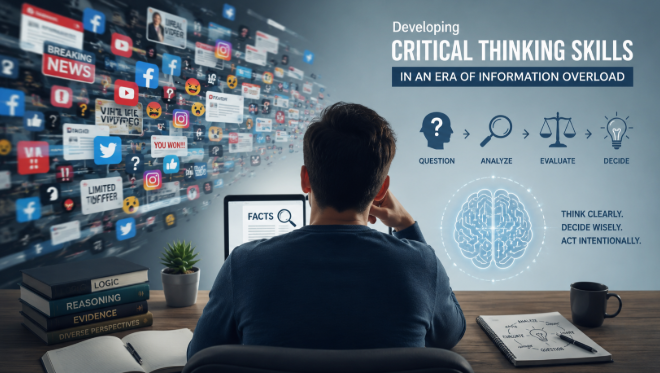
Understanding Critical Thinking
Critical thinking is defined as the ability to think clearly and rationally, understanding the logical connection between ideas. It involves the evaluation of information, enabling individuals to analyze arguments, identify biases, and assess the validity of various sources. In today’s world, where information is readily available but often overwhelming and misleading, critical thinking becomes an essential skill for navigating complex data. By fostering these skills, individuals are better equipped to discern credible information from falsehoods, which is crucial in making informed decisions.
The importance of critical thinking is magnified in our current information landscape characterized by relentless streams of content from social media, news outlets, and online platforms. Each piece of information carries with it a certain level of bias or perspective; thus, critical thinking skills enable individuals to approach these sources with a judicious mindset. Accordingly, one can incorporate the evaluation of evidence, identification of assumptions, and consideration of alternative viewpoints, all of which are essential components of informed decision-making.
Empowering oneself with critical thinking skills means cultivating the ability to synthesize information thoughtfully. This process entails gathering various pieces of information, analyzing these components, and drawing conclusions based upon a reasoned assessment of the available evidence. By empowering individuals to analyze and synthesize diverse forms of information, critical thinking fosters a mindset equipped to tackle the complexities of contemporary issues. As a result, one becomes not just a passive consumer of information but an active participant in the discourse surrounding that information, ensuring greater engagement with societal challenges.
The Challenge of Information Overload
In the digital age, individuals are constantly bombarded with an unprecedented volume of information, leading to what is commonly referred to as information overload. This phenomenon affects individuals across various demographics, from students to professionals, creating a significant challenge in the development of critical thinking skills. The sheer abundance of content available through various platforms—including social media, news websites, and academic journals—can contribute to feelings of confusion and overwhelm.
Information overload can manifest in multiple ways. For instance, when faced with an influx of data, individuals often struggle to distinguish between reliable sources and misinformation. This confusion can lead to poor decision-making, as navigating through vast amounts of content without a clear strategy can impede one’s ability to engage in critical analysis. The more data one encounters, the more difficult it becomes to assess its validity, relevance, and implications.
Furthermore, the stress associated with sifting through excessive information can negatively impact cognitive processes. The difficulty in focusing on key points, combined with the constant interruptions from notifications and updates, can fragment attention and reduce the capacity for deep thinking. As a result, individuals may experience cognitive fatigue, decreasing their overall ability to engage critically with the information at hand.
Ultimately, the challenge of information overload requires individuals to develop strategies for managing their consumption of data effectively. This includes organizing information, prioritizing reputable sources, and cultivating the ability to synthesize diverse viewpoints. Addressing this challenge is crucial, as it not only enhances critical thinking skills but also empowers individuals to make informed choices amid the chaos of digital information.
Identifying Reliable Sources
In today’s environment saturated with information, distinguishing credible sources from unreliable ones has become imperative for cultivating critical thinking skills. One of the most dependable methods for ensuring the reliability of information is to prioritize peer-reviewed journals. These publications undergo rigorous evaluation by experts in the field before publication, which helps to verify the validity of the research and its conclusions. When looking for data or studies to inform your understanding, favoring these scholarly articles can greatly enhance your critical thinking capabilities.
Additionally, established news outlets play a vital role in providing trustworthy information. These organizations often adhere to strict reporting standards and practices, ensuring that the news disseminated to the public is factual and well-supported. Seeking news from reputable sources helps in filtering out misinformation and enables individuals to analyze events and topics backed by solid journalistic research. Comparison among various outlets can also aid in developing a well-rounded perspective on current events.
Furthermore, the opinions of recognized experts in relevant fields contribute to identifying reliable information. Listening to perspectives from thought leaders or documented authorities can present well-informed viewpoints and deeper insights into complex issues. Engaging with expert analyses and critiques allows individuals to develop a critical lens through which they can evaluate competing claims within a wide range of subjects.
Ultimately, navigating the vast landscape of information requires a discerning approach. By leveraging peer-reviewed journals, established media outlets, and expert perspectives, individuals can foster a more critical thinking orientation and make well-informed decisions. The integration of these strategies into research practices will enhance both personal and collective understanding in an era where the abundance of information is both a privilege and a challenge.
The Role of Inquiry and Curiosity
In the contemporary landscape of information overload, fostering a curious mindset is essential for the development of critical thinking skills. Curiosity serves as the foundation upon which critical thinking is built, encouraging individuals to engage actively with the world around them. By nurturing a sense of inquiry, one can effectively challenge assumptions, explore various perspectives, and seek deeper understanding of complex issues.
Asking questions is a vital component of critical thinking. Whether in academic settings, professional environments, or daily life, questions lead to exploration and discernment. For example, when confronted with a new concept or piece of information, rather than accepting it at face value, one should probe further: What evidence supports this claim? Are there alternative viewpoints? What are the implications of this information? This method of inquiry not only enriches one’s understanding but also cultivates a more comprehensive analysis of the situation at hand.
Moreover, being open to new ideas enhances critical thinking by allowing the individual to consider viewpoints that may differ from their own. It is essential to recognize that the understanding of a subject can often be expanded by incorporating diverse perspectives. Engaging with opposing viewpoints fosters intellectual flexibility and enhances one’s ability to navigate complex information landscapes. By embracing the unknown and being willing to learn from others, individuals sharpen their critical thinking abilities, making them more adept at processing and interpreting the vast amounts of information they encounter daily.
Ultimately, a curious mindset, characterized by persistent inquiry and openness to new ideas, is indispensable in the pursuit of effective critical thinking in an age awash with information. This approach not only equips individuals with the tools to analyze and synthesize information thoughtfully but also prepares them to adapt in an ever-evolving world.
Practicing Reflective Thinking
In today’s fast-paced environment where information is readily available, practicing reflective thinking has become an essential skill. Reflective thinking processes enable individuals to critically analyze their own thoughts, including biases that may influence their decision-making. Engaging in reflective exercises can lead to enhanced awareness and a better understanding of one’s cognitive patterns.
One effective method to enhance reflective thinking is through journaling. This practice involves regularly documenting thoughts, feelings, and experiences. By writing down daily reflections, individuals can begin to recognize recurring themes and personal biases. Journaling encourages individuals to critically evaluate their experiences and the reasoning behind their beliefs. The act of writing serves as a powerful tool for fostering self-awareness and promoting cognitive clarity.
Another valuable approach to developing reflective thinking skills is participating in discussions with peers. These conversations can take place in informal settings or structured environments, such as workshops or study groups. Engaging with others allows individuals to articulate their thoughts, confront differing viewpoints, and consider alternative perspectives. Such discussions stimulate critical dialogue, prompting participants to reassess and refine their own understanding of various topics.
Self-assessment exercises also play a crucial role in reflective thinking. By evaluating one’s skills, knowledge, and experiences, individuals can identify areas for growth and improvement. Utilizing tools such as self-assessment questionnaires or reflection prompts can guide this process. This self-evaluation encourages honest appraisal and helps individuals recognize cognitive biases, paving the way for informed decision-making and a balanced perspective.
Integrating these methods into daily routines can significantly enhance one’s capacity for critical thinking. As individuals become more adept at reflective thinking, their ability to process information judiciously and respond thoughtfully to complex issues will naturally improve. This growth is imperative, especially in an era characterized by information overload and diverse viewpoints.
Applying the Socratic Method
The Socratic Method, named after the ancient Greek philosopher Socrates, serves as a powerful tool for fostering critical thinking. This pedagogical technique revolves around engaging individuals in dialogue, encouraging them to explore the depths of their understanding by asking a series of probing questions. The goal of this method is not merely to convey information, but to stimulate profound analysis and self-reflection.
One of the hallmark techniques of the Socratic Method is the practice of questioning. By posing open-ended questions, educators and facilitators can guide participants towards formulating their thoughts and uncovering underlying assumptions. These questions might include inquiries such as, “What do you mean by that?” or “How did you come to that conclusion?” Such inquiries challenge individuals to think critically about their responses, ensuring they engage with the material on a deeper level.
Examining assumptions is another key element of the Socratic Method. Participants are encouraged to scrutinize their beliefs and the foundational ideas underlying them. This can lead to a more nuanced understanding as individuals confront potential biases or misconceptions. By reflecting on the validity of their beliefs, learners cultivate the ability to differentiate between mere opinion and evidence-based conclusions.
In a landscape saturated with information, applying the Socratic Method allows individuals to navigate complex ideas and differentiate between credible sources and misinformation. Through rigorous questioning and critical evaluation of assumptions, individuals not only enhance their critical thinking skills but also develop a habit of intellectual curiosity. This method empowers learners to engage with diverse perspectives, a necessary skill in an era where information overload can often cloud judgment.
Embracing Diverse Perspectives
The foundation of critical thinking lies in the understanding that knowledge is not monolithic but rather a tapestry woven from myriad perspectives. In our era of information overload, saturated with conflicting opinions, embracing diverse viewpoints becomes essential. Engaging with different perspectives challenges our preconceptions and encourages a deeper examination of our beliefs. This active pursuit of understanding diverse thoughts fosters an environment where critical thinking can thrive.
When we are willing to confront viewpoints that differ from our own, we initiate a critical dialogue with ourselves and others. This process is not simply about tolerating differing opinions; it involves an earnest exploration of the reasoning behind those views. By asking questions, seeking evidence, and considering alternative explanations, we sharpen our analytical skills and develop a more nuanced understanding of complex issues. This approach not only enhances our critical thinking abilities but also equips us to navigate the vast landscape of information we encounter daily.
Moreover, exposure to diverse perspectives can counteract biases that may cloud our judgment. Often, our views are shaped by limited personal experiences or echo chambers that reinforce existing beliefs. Engaging with contrasting views can disrupt this cycle, compelling us to reevaluate what we know and how we perceive the world. It is through this process of critical reflection that we cultivate a more comprehensive understanding of our society and the various factors that influence it.
Incorporating diverse viewpoints into our cognitive toolkit enables us to approach problems with creativity and flexibility. By recognizing the validity of different opinions and experiences, we can cultivate empathy and open-mindedness, essential elements of critical thinking. As we navigate through the myriad narratives that shape our understanding, embracing diversity not only enhances our critical thinking skills but also enriches our personal growth.
Building a Critical Thinking Routine
In an age characterized by information overload, establishing a critical thinking routine is essential for navigating daily decision-making processes effectively. By integrating structured practices into one’s daily life, individuals can enhance their ability to analyze information critically and make informed choices. Here are several practical tips to help foster a critical thinking habit.
Firstly, consider setting aside time each day dedicated to reflective thinking. This could be as simple as journaling for 10-15 minutes about various topics or personal experiences. Reflective writing encourages individuals to articulate their thoughts clearly and reconsider their viewpoints. It serves as an effective method for examining assumptions and evaluating arguments critically.
Secondly, cultivate the habit of asking questions. Developing a questioning mindset can significantly enhance critical thinking skills. Instead of accepting information at face value, challenge yourself to inquire deeper. Ask questions like, “What evidence supports this claim?” or “What are the alternative viewpoints?” This practice encourages a more nuanced understanding of complex issues and promotes analytical thinking.
Moreover, engaging in discussions with others can also foster critical thinking. Collaborating with friends, family, or colleagues can present diverse perspectives that provoke thought and introspection. Create a regular opportunity, such as a weekly discussion group, to debate different ideas. Such interactions can sharpen one’s analytical abilities and broaden one’s understanding, leading to improved decision-making.
Lastly, consider utilizing resources that promote critical thinking skills, such as books or online courses. Numerous materials are specifically designed to enhance these skills through exercises and case studies. Engaging with these resources can provide foundational knowledge and actionable strategies to incorporate critical thinking into daily life.
Conclusion: The Path Forward
In an age characterized by rapid information dissemination and an overwhelming influx of data, the cultivation of critical thinking skills emerges as an indispensable asset. As individuals navigate through diverse perspectives and varying degrees of credibility among sources, an acute ability to assess, analyze, and reflect on information becomes vital. Critical thinking empowers individuals to make informed decisions rather than impulsive conclusions based on superficial analysis.
The long-term benefits of developing these skills extend far beyond immediate personal gain. In the professional arena, employees equipped with critical thinking abilities are more adept at problem-solving, innovation, and strategic planning. Such qualities not only enhance individual performance but also contribute to organizational success in an increasingly competitive marketplace. Furthermore, as the demand for adaptable and autonomous thinkers rises, those who prioritize critical thinking are more likely to excel in their careers and assume leadership roles.
Moreover, critical thinking fosters lifelong learning. By encouraging an inquisitive mindset, individuals are more inclined to seek new knowledge and challenge the status quo. This dedication to continuous improvement supports personal growth and enhances one’s ability to engage constructively with others across various disciplines and cultural backgrounds. To sustain this growth, it is crucial for individuals to engage in regular practice of their critical thinking skills through activities such as discussions, writing, and reflective journaling.
As we move forward in this information-saturated landscape, investing in the development of critical thinking should not be perceived merely as an academic exercise, but rather as a critical life skill that underpins effective decision-making and personal empowerment. By committing to ongoing learning and practice in this essential competence, individuals will be better prepared to tackle the complexities of modern life and contribute positively to society.