

Few sensations are as unsettling as pressing the accelerator and feeling the engine rev without the car actually speeding up. This is one of the clearest signs that your clutch may be slipping. A slipping clutch is common in manual vehicles and usually develops gradually rather than failing without warning. Recognising the early symptoms can help you avoid being caught out by a complete clutch failure and may prevent additional damage to related components.
Your clutch transfers power from the engine through the gearbox to the wheels. When the clutch cannot maintain a firm grip, the engine can rev freely while the vehicle gains speed slowly or not at all. The problem is often most noticeable during hard acceleration, overtaking, hill starts or when carrying a heavy load.
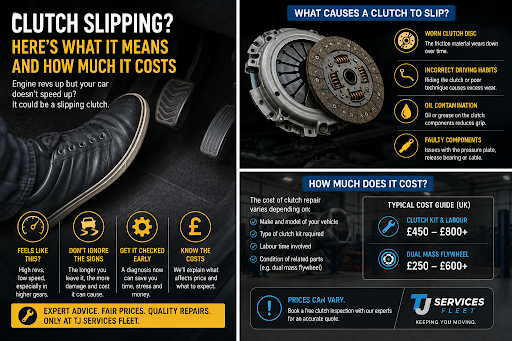
This guide explains what clutch slipping means, the most common warning signs and causes, how the fault is diagnosed, what affects the repair and how much a clutch replacement can cost.
What Does It Mean When a Clutch Slips?
Your clutch is responsible for transferring power from the engine to the gearbox, engaging and disengaging smoothly every time you change gear. When it slips, this means the clutch is not maintaining a solid connection between the engine and the transmission, so some of the engine’s power is lost rather than being transferred to the wheels.
This typically shows up as the engine revving higher than expected for your road speed, particularly under acceleration or when climbing a hill, without a corresponding increase in speed. It can feel similar to trying to accelerate in too high a gear, except it persists regardless of which gear you select.
How Much Does a Clutch Replacement Cost?
The cost of replacing a clutch varies significantly between vehicles, so there is no single price that applies to every car. The final bill depends on the vehicle’s make and model, the accessibility of the clutch assembly, the parts required and whether related components such as the flywheel also need attention.
Labour can make up a significant part of the total because the gearbox normally needs to be removed to reach the clutch assembly. A standard clutch replacement may therefore cost considerably less than a repair that also requires a dual-mass flywheel or another related component to be replaced.
For an accurate price, the vehicle needs to be assessed first. A technician can then confirm whether the clutch itself is worn, whether contamination or another fault is responsible, and which components actually need replacing.
Common Signs of a Slipping Clutch
The symptoms of clutch slip can vary depending on the vehicle and how worn the clutch is, but these are some of the most common signs drivers notice.
1. Engine Revs Increase Without Matching Acceleration
This is the clearest and most recognisable symptom. You press the accelerator, the engine note rises, but the car does not gain speed at the rate you would expect, particularly noticeable when overtaking or driving uphill.
2. Burning Smell
A distinctive burning smell, similar to burning rubber or hot dust, often accompanies a slipping clutch. This happens because the clutch plate is generating excess friction and heat as it fails to grip properly.
If the smell becomes strong or appears repeatedly, avoid continued hard acceleration and have the clutch inspected before further driving causes additional heat and wear.
3. Difficulty Accelerating, Especially Uphill
Hills place extra demand on the clutch, so slipping often becomes most noticeable when climbing an incline, where the car struggles to gain speed despite higher revs.
If the smell becomes strong or appears repeatedly, avoid continued hard acceleration and have the clutch inspected before further driving causes additional heat and wear.
4. High Biting Point
If the point at which the clutch engages, known as the biting point, gradually rises higher and higher as you release the pedal, this is a common early indicator that the clutch plate is wearing thin.
A high biting point does not always mean the clutch is failing, but a noticeable change from how the pedal normally feels is worth having checked, especially when combined with slipping under acceleration.
5. Reduced Fuel Efficiency
Because engine power is not being transferred efficiently to the wheels, a slipping clutch can gradually reduce fuel economy. The engine may need to work harder and run at higher revs to maintain the same road speed, particularly during acceleration or uphill driving.
However, poor fuel economy on its own does not confirm a clutch problem because many other engine and vehicle faults can increase fuel consumption. It becomes more significant when it appears alongside symptoms such as rising revs, poor acceleration or a burning smell.
6. Gear Changes Feel Vague or Unresponsive
Some drivers describe a slipping clutch as making gear changes feel disconnected or spongy, distinct from the crisp engagement of a healthy clutch.
Some drivers describe a slipping clutch as making gear changes feel disconnected, vague or spongy, rather than giving the firm engagement expected from a healthy clutch. You may notice that the clutch pedal feels different from normal or that the car takes longer to respond after releasing the pedal. However, difficulty selecting gears can also point to a clutch hydraulic, cable or gearbox problem, so this symptom should be considered alongside other signs such as rising engine revs and poor acceleration.
What Causes a Clutch to Slip
A clutch can start slipping for several reasons, and normal wear is only one of them. Driving habits, fluid contamination, damaged clutch components and incorrect fitting can all affect how well the clutch transfers engine power to the wheels. Identifying the underlying cause is important because replacing the clutch without addressing the original problem could allow the same issue to return.
Normal Wear Over Time
Like brake pads, clutch plates wear down gradually through everyday use. Every gear change causes a small amount of friction material to wear away, and eventually there is not enough material left to grip effectively.
Aggressive or Frequent Clutch Use
Riding the clutch, resting your foot on the pedal while driving, or frequent stop start traffic can accelerate wear considerably faster than normal usage.
Oil or Fluid Contamination
If oil or coolant leaks onto the clutch plate, it significantly reduces its ability to grip, causing slipping that is unrelated to normal wear and tear.
Worn Pressure Plate or Release Bearing
The clutch plate is not the only component that can cause engagement problems. The pressure plate applies the force needed to hold the clutch disc against the flywheel, while the release bearing allows the clutch to disengage when you press the pedal. Wear or damage to either component can affect how consistently the clutch engages and may contribute to slipping, unusual pedal feel or noise. Because these components work together, technicians will normally inspect the complete clutch assembly when the gearbox is removed.
Incorrect Clutch Adjustment or Fitting
On some vehicles, an incorrectly adjusted or poorly fitted clutch can behave as though it is slipping even when the friction plate is not significantly worn. This is particularly worth considering if the symptoms started shortly after clutch work was carried out. Incorrect adjustment can prevent the clutch from fully engaging, while poor installation can affect how the components operate together. If slipping begins soon after a clutch replacement, the previous repair should be checked before assuming the clutch has simply worn out again.
A Quick Reference Table: Signs and Likely Cause
| Sign | Likely Explanation |
| Revs rise without matching speed | Worn clutch plate losing grip |
| Burning smell | Excess friction and heat at the clutch |
| Struggling on hills | Reduced power transfer under load |
| Rising biting point | Gradual wear of friction material |
| Reduced fuel economy | Engine working harder for the same output |
| Vague gear changes | Inconsistent engagement |
How Driving Style Affects Clutch Lifespan
Clutch wear is not purely a matter of mileage, driving style plays a significant role too. Frequent short journeys in heavy traffic place far more strain on a clutch than steady motorway driving, simply due to the sheer number of gear changes and partial engagements involved. Resting a foot lightly on the clutch pedal while driving, even without fully pressing it, causes a small amount of continuous slippage that adds up considerably over time.
Towing, carrying heavy loads, or frequently pulling away on inclines also increases wear, since these situations demand more from the clutch at the exact moment it is most vulnerable, during initial engagement. Being mindful of these habits will not eliminate wear altogether, but it can meaningfully extend how long a clutch lasts before slipping becomes noticeable.
| Driving Habit | Effect on Clutch Wear |
| Frequent stop start traffic | Increases wear significantly |
| Resting foot on clutch pedal | Causes continuous minor slippage |
| Towing or heavy loads | Increases strain during engagement |
| Steady motorway driving | Minimal additional wear |
| Frequent hill starts | Increases wear at engagement point |
Clutch Slipping Versus Other Similar Faults
It is worth distinguishing a slipping clutch from a few other faults that can feel superficially similar. A worn clutch cable or hydraulic fault can cause the pedal to feel unusually soft or inconsistent, without necessarily involving the clutch plate itself slipping. A failing gearbox can sometimes produce symptoms that feel similar under load, though this is typically accompanied by grinding or difficulty selecting gears rather than a smooth loss of power. Engine performance issues, such as a fault with fuel delivery, can also reduce acceleration, but usually without the distinctive rev and speed mismatch that characterises genuine clutch slip.
| Fault | Key Distinguishing Feature |
| Slipping clutch | Revs rise without matching road speed |
| Worn clutch cable or hydraulics | Pedal feels soft or inconsistent |
| Gearbox fault | Grinding, difficulty selecting gears |
| Engine performance issue | Reduced power, but revs match road speed |
How a Slipping Clutch Is Diagnosed
A common diagnostic test involves driving the car in a higher gear than usual at a steady speed, then accelerating firmly. If the engine revs rise noticeably faster than the car’s speed, this is a strong indicator of clutch slip.
Experienced technicians at TJ Services Fleet can use these symptoms, together with a controlled road test and physical inspection, to determine whether the clutch itself is slipping or whether another component is contributing to the problem.
Further inspection may be needed to determine the extent of the problem and whether another fault is contributing to the slipping. If the gearbox has to be removed, the clutch plate, pressure plate and release bearing can be inspected for wear, heat damage or contamination. The flywheel should also be checked because prolonged clutch slipping can generate enough heat to damage its surface.
Experienced technicians will also consider the circumstances in which the slipping occurs rather than relying on one symptom alone. For example, slipping that appears mainly under heavy acceleration may point towards a worn clutch, while a problem that started immediately after clutch replacement may require the previous fitting or adjustment to be checked.
What Influences the Overall Repair
Clutch replacement is a labour-intensive job, since it typically requires removing the gearbox to access the clutch assembly, which is why the process itself, rather than the parts alone, plays such a large role in the overall repair. A few factors specifically affect how involved this becomes.
Vehicle layout. Some vehicles have engine and gearbox arrangements that are more accessible than others, which affects how long the job takes.
Extent of the damage. If the slipping has been left unaddressed for a long time, the flywheel can also become damaged, sometimes requiring resurfacing or replacement alongside the clutch itself, adding to the overall job.
Additional components replaced. It is common practice to replace the clutch plate, pressure plate and release bearing together as a full kit, even if only one component initially failed, since they wear at a similar rate and are all exposed once the gearbox is removed.
Underlying cause. A slipping clutch caused by an oil leak, for example, requires that leak to be fixed as well, or the replacement clutch will suffer the same fate prematurely.
Because we avoid providing specific figures here, the best way to understand cost for your particular vehicle is a proper inspection, since the true scope of the job only becomes clear once a technician has assessed the extent of wear and any contributing factors.
Can a Slipping Clutch Be Prevented?
While wear is inevitable over the life of a vehicle, a few habits can meaningfully extend how long a clutch lasts. Avoiding unnecessary clutch use, such as resting a foot on the pedal or holding the car on a hill using the clutch rather than the handbrake, reduces unnecessary friction. Changing gear smoothly, rather than rushing or slipping the clutch during quick pull aways, also reduces wear over time.
Addressing any oil or fluid leaks promptly prevents contamination-related slipping, which is unrelated to normal wear and entirely avoidable with timely maintenance.
Why Catching This Early Matters
A slipping clutch rarely fails without warning, which means there is usually a window where the symptoms are present but the car remains fully driveable. Continuing to drive with a significantly slipping clutch, however, accelerates wear on the flywheel and can eventually leave you unable to select gears at all, often at an inconvenient moment. Booking the car in as soon as symptoms appear, rather than waiting for a complete failure, generally means a more contained repair.
How This Relates to Servicing and MOT Checks
While clutch condition is not typically part of a standard MOT test, a technician may notice early signs of slipping during a test drive if it is pronounced enough, and this is worth mentioning if you have already noticed symptoms yourself.
Routine car servicing in Fleet does not automatically include a clutch inspection, but it is a good opportunity to raise any concerns about clutch pedal feel, slipping, or difficulty changing gear so they can be properly assessed.
Conclusion
A slipping clutch is one of those faults that tends to announce itself gradually, through rising revs that do not match road speed, a faint burning smell, or a biting point that keeps creeping higher, long before it becomes a genuine inconvenience. Understanding what is actually happening beneath the surface, a loss of grip between the engine and gearbox, makes it much easier to recognise the early signs rather than dismissing them as an odd quirk of the car.
What affects the eventual repair is rarely just the clutch plate itself, but the labour involved in accessing it, the condition of related components like the flywheel, and whether an underlying cause such as a leak needs addressing too. Because of this, a proper inspection is always the most reliable way to understand what your specific situation involves. Acting on early symptoms, rather than waiting for the clutch to fail completely, remains the simplest way to keep the eventual repair as straightforward and contained as possible.
If you’ve noticed these symptoms and want to have the clutch checked, you can get directions to TJ Services Fleet on Google before arranging your visit.
Frequently Asked Questions
Can I still drive with a slipping clutch?
In the short term, yes, though it is best treated as a sign to get the car checked soon, since continued driving accelerates wear on related components like the flywheel.
How long do clutches usually last?
This varies considerably depending on driving style and conditions, with frequent stop start traffic and towing typically shortening lifespan compared to steady motorway driving.
Why does my clutch smell like it is burning?
This happens because a slipping clutch generates excess friction and heat as it fails to grip properly, producing a smell similar to burning rubber or hot dust.
Is a slipping clutch the same as a faulty clutch cable?
No, a faulty cable or hydraulic system typically causes a soft or inconsistent pedal feel, while a genuinely slipping clutch involves the plate itself losing grip.
Does a slipping clutch always mean a full replacement is needed?
Not necessarily. In some cases, contamination from an oil leak or a fitting issue can cause slipping without significant wear, though a proper inspection is the only way to confirm this.