


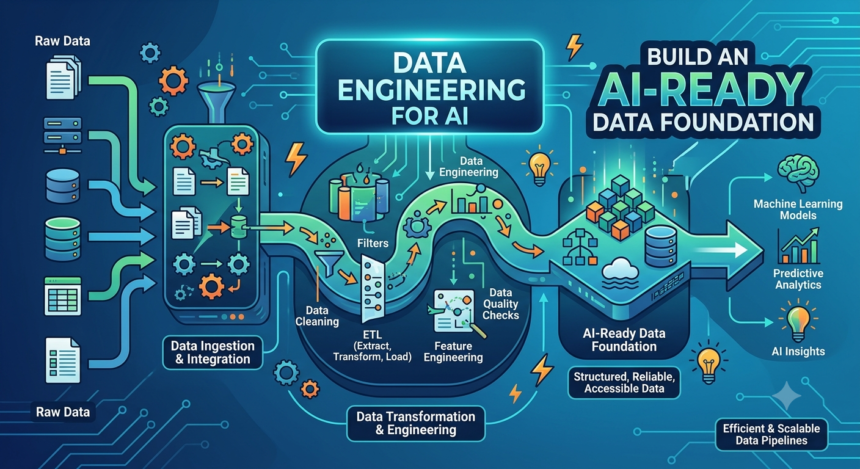
Data Engineering for AI: Building the Foundation That Makes AI Work
AI models are only as good as the data beneath them. This guide explains what data engineering for AI involves, how it differs from traditional pipelines, and how the right foundation turns stalled experiments into production-ready systems.
| ⚡ QUICK ANSWER
Data engineering for AI is the practice of building pipelines, architectures, and quality controls that prepare data specifically for machine learning and generative AI. In short, it goes beyond traditional ETL to deliver clean, governed, and AI-ready data, so models train reliably and perform well in production. |
Why Data Engineering Is the Backbone of AI
Most AI failures are not caused by weak models. Instead, they trace back to messy, fragmented, or ungoverned data. Consequently, the quality of your data foundation often decides whether an AI project succeeds or stalls.
The evidence here is hard to ignore. For example, Gartner predicts that through 2026, organizations will abandon 60% of AI projects that are not supported by AI-ready data. Moreover, the same research found that 63% of organizations either lack or are unsure they have the right data management practices for AI. In other words, the constraint is rarely the algorithm.
Because of this pattern, leaders are shifting their attention upstream. Therefore, they invest in data engineering first, then build models on top. Ultimately, this order is what separates the projects that scale from the ones that quietly disappear.
| INDUSTRY INSIGHT
AI-ready data is a stricter standard than analytics-ready data. Specifically, it requires continuous quality, active metadata, lineage, and governance applied at the cadence the model consumes data, not the cadence a reporting team uses. |
What Is Data Engineering for AI?
Data engineering for AI is the discipline of designing systems that ingest, process, and serve data specifically for machine learning and generative AI. Rather than simply moving data for reporting, it prepares data to train, ground, and power intelligent systems. As a result, it demands new patterns, tighter quality controls, and closer collaboration between data and AI teams.
In practice, this work spans the full data lifecycle. First, it covers ingestion from many sources, including unstructured and real-time streams. Next, it adds transformation, feature engineering, and storage designed for models. Finally, it layers in governance, observability, and compliance. Together, these steps turn raw data into a dependable fuel for AI.
| THE REALITY
Traditional data management was built for reporting, where “close enough” often worked. However, AI models in production need data quality signals measured in hours, not quarters. Therefore, bolting AI onto a reporting-era foundation is where many initiatives quietly break. |
How AI Data Engineering Differs From Traditional ETL
Traditional pipelines were designed to feed dashboards and periodic reports. AI pipelines, by contrast, feed models that learn and generate. Consequently, the requirements change in several important ways.
| Dimension | What Changes for AI |
| Data types | Shifts from mostly structured tables to unstructured text, images, and real-time streams |
| Cadence | Moves from batch reporting cycles to continuous, low-latency freshness |
| Quality bar | Requires stricter, continuously measured quality rather than periodic checks |
| New components | Adds feature stores, vector databases, and retrieval pipelines for RAG |
| Collaboration | Demands tight partnership between data engineers and data scientists |
Because these differences compound, teams cannot simply reuse old pipelines. Instead, they must design for the specific demands of machine learning and generative AI from the start.
Our Data Engineering for AI Services
Impressico builds the complete data foundation that AI systems depend on. Furthermore, each capability is designed to make your data reliable, governed, and model-ready. Below are the core areas we deliver.
1. Data Ingestion and Integration
AI needs data from many sources, often in real time. Accordingly, we build robust pipelines that unify structured, unstructured, and streaming data. As a result, your models draw on a complete, current view rather than fragmented silos.
2. Data Pipelines and Architecture
Reliable pipelines are the heart of production AI. Therefore, we design scalable architectures, including modern lakehouse patterns, that handle volume and variety. In turn, your systems stay dependable as data grows.
3. Feature Engineering and Feature Stores
Models are only as strong as the features that feed them. For this reason, we engineer high-quality features and manage them in shared feature stores. Consequently, teams reuse trusted features instead of rebuilding them for every project.
4. Vector Databases and RAG Pipelines
Generative AI needs grounded, retrievable knowledge. Accordingly, we implement vector databases and retrieval-augmented generation pipelines. To go further, explore our generative AI and LLM services. As a result, your AI produces accurate, context-aware responses.
5. Data Quality and Observability
Poor data quality quietly undermines even strong models. Therefore, we build automated quality gates and continuous observability into every pipeline. Because of this discipline, issues get caught early rather than surfacing in production.
6. Governance, Lineage, and Compliance
Trust and compliance matter more than ever in AI. For that reason, we apply active metadata, lineage tracking, and governance across your data estate. In turn, your AI stays auditable, responsible, and regulation-ready.
| Not sure if your data is AI-ready? Talk to our experts and assess your data foundation. |
Our Data Engineering for AI Process
A structured process turns data chaos into a dependable AI foundation. Therefore, we follow a clear, staged path from assessment to continuous improvement. Each phase produces concrete outcomes, so progress stays visible.
Step 1: Data Readiness Assessment
First, we assess your current data landscape, quality, and gaps. In addition, we map the data your priority AI use cases actually depend on. As a result, you start with a clear, prioritized plan rather than guesswork.
Step 2: Architecture and Pipeline Design
Next, we design the architecture and pipelines your models require. Because scalability matters, we build for production volume from the outset. Consequently, the foundation holds up as demand grows.
Step 3: Quality, Governance, and Observability
Then, we embed automated quality gates, governance, and monitoring. Meanwhile, we establish lineage and active metadata for full traceability. Because of this, your data stays trustworthy over time.
Step 4: Delivery and Continuous Optimization
Finally, we serve model-ready data and keep the system healthy. In particular, we monitor freshness, watch for drift, and refine continuously. Ultimately, this ongoing care keeps your AI performing long after launch.
Industry Applications
AI-ready data creates value in every sector. For that reason, we tailor each foundation to industry-specific data and rules. Below are a few examples.
- Healthcare: We unify clinical and operational data, so models support diagnostics and patient care safely.
- Financial services: We consolidate customer data across systems, so AI powers fraud detection and credit decisions accurately.
- Retail and e-commerce: We integrate behavioral and transactional data, so recommendation and personalization models perform well.
- Manufacturing: We connect sensor and operational data, so predictive maintenance and quality models stay reliable.
| KEY TAKEAWAY
AI-ready data is contextual and use-case dependent. Therefore, the strongest foundations are built around the specific decisions your models must support, not as a generic, one-time cleanup exercise. |
Business Benefits of Strong Data Engineering for AI
When your data foundation is solid, AI finally delivers on its promise. Moreover, the benefits compound across the organization. Here are the outcomes teams see most often.
- Higher model accuracy: Clean, well-governed data produces more reliable and trustworthy outputs.
- Faster time to production: Reusable pipelines and features shorten the path from pilot to launch.
- Lower risk of failure: A strong foundation avoids the data gaps that stall most AI projects.
- Better compliance: Lineage and governance keep AI auditable and regulation-ready.
- Scalable AI: Well-architected data systems support many models without constant rework.
Why Choose Impressico for Data Engineering
Choosing the right data partner matters more than choosing any single tool. Accordingly, we combine deep engineering expertise with a practical, outcomes-first mindset. In addition, we work as an extension of your team from assessment through long-term support.
Our broader capabilities strengthen every engagement as well. For instance, our machine learning engineering and agentic AI teams help you turn a strong data foundation into working intelligent systems. Because of that depth, we deliver data engineering that is both rigorous and production-ready.
Frequently Asked Questions
What is data engineering for AI?
It is the practice of building pipelines and architectures that prepare data specifically for machine learning and generative AI. In practice, it extends traditional ETL with feature engineering, vector databases, and continuous quality controls.
How is it different from regular data engineering?
Traditional data engineering mainly feeds reporting and dashboards. However, AI data engineering feeds models that learn and generate. Therefore, it demands stricter quality, real-time freshness, and new components like feature stores and RAG pipelines.
Why do so many AI projects fail on data?
Most failures stem from fragmented, inconsistent, or ungoverned data. Because models depend entirely on their inputs, poor data leads directly to poor outputs. As a result, the data foundation must come first.
What does AI-ready data actually mean?
AI-ready data is aligned to specific use cases, actively governed, and continuously quality-assured. Moreover, it carries active metadata and lineage, so models and their users can trust every data asset.
[Do we need to fix all our data before starting?
Not at all. Instead, we recommend starting with the data your highest-value use cases depend on. Accordingly, you build readiness iteratively rather than attempting a costly, all-at-once overhaul.
| KEY TAKEAWAYS
• Data engineering is the backbone of every successful AI system. • AI data engineering goes well beyond traditional ETL and reporting pipelines. • Most AI projects fail on data, not on the model itself. • Start with the data your highest-value use cases depend on. |
| Ready to build an AI-ready data foundation? |
Partner with Impressico to turn your data into a reliable engine for AI. Contact our team to get started, or explore our data engineering services to see what is possible.