

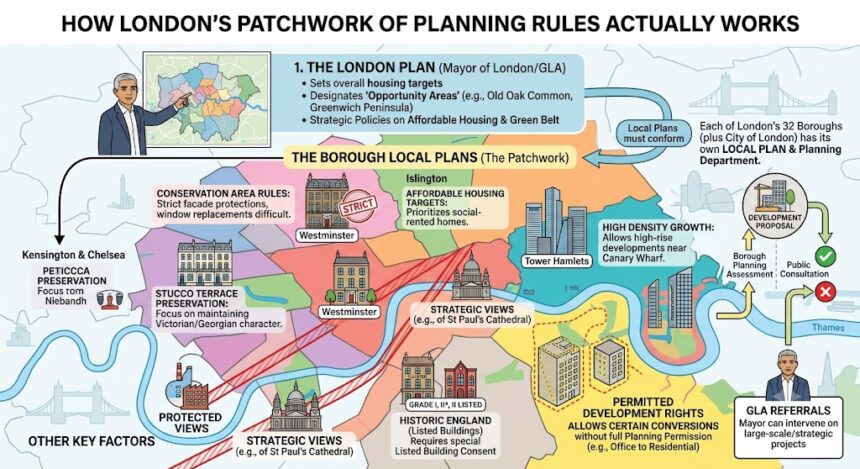
London doesn’t have one planning system. It has 33 of them, one per borough, each interpreting national policy through its own local lens. That’s why an identical rear extension can sail through in one postcode and get refused two streets over in another borough entirely. Understanding this patchwork is the single most useful thing to grasp before hiring architects in london for any extension project.
Why Do Identical Extensions Get Different Outcomes in Different Boroughs?
Permitted development rights are set nationally under the GPDO 2015, but each council retains the power to remove those rights on specific streets through an Article 4 Direction. This is a legal mechanism, not a guideline, and it means the same single storey rear extension that requires no application whatsoever on one street might need a full planning submission on the street next door, purely because that borough decided years ago to protect the area’s character through tighter control.
Councils also interpret the NPPF paragraph 154 test for Green Belt extensions differently in practice, even though the national policy wording is identical everywhere. A roughly 50% volume uplift over the original building is the commonly applied benchmark for what counts as a disproportionate addition, but how strictly individual case officers apply that test varies by council, and sometimes by which officer happens to review the file.
What Actually Determines Whether You Need Full Planning Permission?
Three factors decide this, and none of them are obvious from simply looking at a house:
- Whether an Article 4 Direction applies to the specific street, checkable via the local council’s planning register
- Whether the property sits in a conservation area or is a listed building, which typically removes permitted development rights entirely
- Whether the proposed extension stays within national size and height limits, currently up to 6 metres for terraced and semi-detached properties and 8 metres for detached homes under the Larger Home Extension Scheme, made permanent in May 2024
How Do London Boroughs Actually Differ in Practice?
| Factor | Varies By Borough? | Why It Matters |
| Article 4 Direction coverage | Yes, street by street | Determines if PD rights apply at all |
| Conservation area boundaries | Yes | Removes PD rights, adds design scrutiny |
| Standard decision timeline | Mostly consistent, 8 weeks | Complex cases stretch to 13 weeks everywhere |
| Case officer interpretation of NPPF tests | Yes, in practice | Affects Green Belt and disproportionate addition assessments |
| Pre-application advice fees | Yes | Most boroughs now charge, rates differ |
A Real Example: Putney’s Article 4 Streets
Putney, within the London Borough of Wandsworth, illustrates this well. Large sections of SW15 sit under Article 4 Directions, meaning permitted development rights that would normally apply to Victorian terraces have been removed.putney architects working regularly with Wandsworth Council have found that projects on these streets need a full application from the outset, something a homeowner comparing notes with a friend in a non-Article 4 borough might not expect at all. Wandsworth targets the standard 8-week decision window, but the pre-application groundwork, checking the street’s specific status, tends to add real time before a project even reaches submission.
Does the Borough Affect How Long a Decision Takes?
Not dramatically for standard cases. Most London boroughs, including Wandsworth, target 8 weeks for a householder application from validation, extending to around 13 weeks for conservation areas or more complex proposals. What differs more is the informal timeline, how quickly a borough responds to queries, how backed up their validation process is, and how strictly they interpret submission requirements before accepting an application as complete.
What Should You Check Before Starting Any Design Work?
A short list worth working through regardless of which London borough a property sits in:
- Search the council’s planning register for the specific address, not just the general area
- Confirm whether an Article 4 Direction, conservation area designation, or listed building status applies
- Check whether a previous extension has already used up part of the property’s permitted development allowance
- Ask a practice with genuine experience in that specific borough, not just London generally, what typically gets approved
Why Borough-Specific Experience Matters More Than a Broad London Portfolio
A firm that has worked across many boroughs picks up general familiarity with how planning policy operates nationally. A firm with a sustained, active caseload in one specific borough develops something more useful: pattern recognition for how that particular council’s case officers respond to design choices, material palettes, and boundary proximity. That distinction is often what separates a smooth 8-week approval from a refusal that costs months to resolve.
Getting Clarity on Your Own Borough’s Rules
With 17 years of experience and over 1,800 planning approvals across London and Surrey, Extension Architecture checks a property’s specific planning status, Article 4 coverage, conservation area boundaries, and remaining permitted development allowance, before any design work is finalised. An in-house structural engineer and RIBA Chartered, ARB registered team manage the full process from feasibility through to building regulations sign off.