


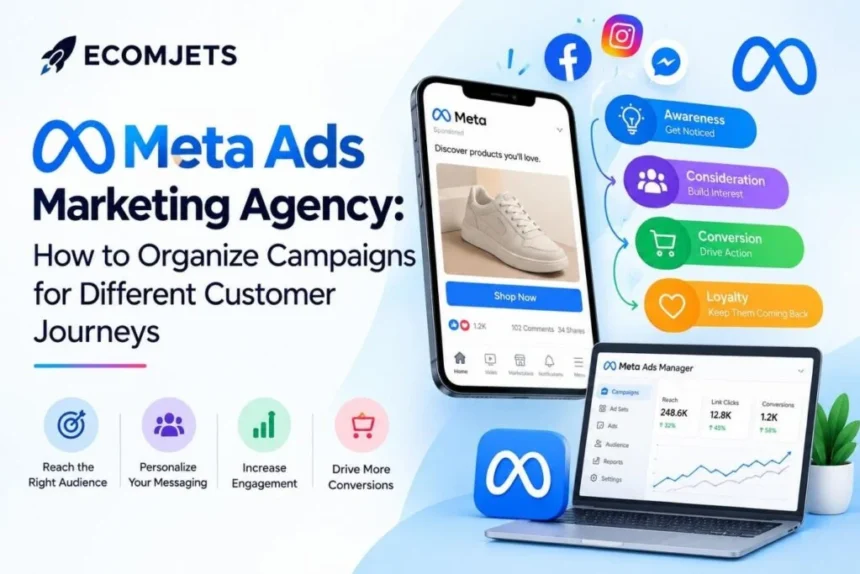
Meta advertising can help businesses reach people across different stages of the buying process. A potential customer may first discover a brand through a video, later engage with a social post, visit the website, and eventually return through a retargeting campaign before taking action.
If every audience receives the same advertisement, the customer journey becomes less relevant. Someone who has never heard of a brand may need education, while someone who has already viewed a product may need reassurance or a clear reason to return.
A Meta ads marketing agency can help organize campaigns around these different stages. The goal is not simply to divide audiences into categories, but to match the message, creative, landing page, and measurement approach to the user’s level of intent.
What Are Meta Ads?
Meta advertising includes paid campaigns distributed through platforms and placements connected to Meta, such as Facebook and Instagram. Depending on the campaign setup, businesses may use advertisements to generate:
- Awareness
- Video views
- Website traffic
- Engagement
- Leads
- Product sales
- App activity
- Retargeting conversions
Campaign options and platform features can change over time. Businesses should use current account settings and follow applicable advertising policies.
Why Customer-Journey Planning Matters
A customer journey describes how someone moves from first discovering a business to taking action. Not every user moves through the process in the same order, but the framework helps marketers organize communication.
A basic structure includes:
- Awareness
- Consideration
- Conversion
- Retention
Each stage has different questions and expectations.
A cold audience may ask, “What is this?” A consideration audience may ask, “Is this right for me?” A conversion audience may ask, “Why should I choose this now?” A previous customer may need education, support, or an additional offer.
Campaign organization should reflect these differences.
Stage One: Awareness Campaigns
Awareness campaigns introduce the brand, product category, or customer problem to people who may not know the business.
Useful awareness content may include:
- Educational videos
- Problem-focused content
- Product demonstrations
- Industry insights
- Brand stories
- Visual explanations
- Short guides
The objective is not always to generate an immediate purchase. Early-stage users may need to understand the problem before they are ready to evaluate a solution.
Creative should be easy to understand without relying on extensive brand knowledge. Avoid assuming that the viewer already understands technical terms or product differences.
Stage Two: Consideration Campaigns
Consideration audiences may have watched a video, interacted with a post, visited the website, or engaged with a previous advertisement. They may now be comparing alternatives or evaluating whether the solution fits their needs.
Content for this stage can include:
- Product or service comparisons
- Demonstrations
- Frequently asked questions
- Case studies
- Reviews, where genuine and permitted
- Feature explanations
- Buying guides
- Process overviews
The message should address barriers that prevent the user from progressing. These may include price uncertainty, product fit, implementation questions, delivery details, or a lack of trust.
A consideration campaign should direct users to a relevant page rather than a generic homepage whenever possible.
Stage Three: Conversion Campaigns
Conversion campaigns target users who have shown stronger intent. Depending on the business, this might include people who:
- Viewed a product
- Added an item to a cart
- Started a form
- Requested information
- Visited a service page
- Engaged repeatedly
- Returned to the website
Conversion creative should make the next step clear. This may be purchasing, booking, requesting a quote, completing a form, or contacting the business.
Useful conversion elements include:
- Clear calls to action
- Accurate pricing or offer information
- Simple forms
- Relevant product details
- Trust signals
- Delivery or service information
- A mobile-friendly experience
Avoid creating artificial urgency or making claims that cannot be supported. Advertising should remain accurate and consistent with the landing page.
Stage Four: Retention and Repeat Engagement
The customer journey does not end after a purchase or lead submission. Existing customers may need:
- Product education
- Setup instructions
- Care information
- Support resources
- Complementary products
- Renewal reminders
- Loyalty communication
Retention campaigns should be carefully separated from acquisition campaigns. Showing a new-customer offer to someone who has already purchased may create confusion or reduce the perceived value of the relationship.
Businesses should also consider excluding recent purchasers from certain acquisition messages when appropriate.
How to Organize Meta Campaigns
A practical structure may separate campaigns by objective, audience stage, or business priority.
For example:
Campaign group one: New audience discovery
Targets broader audiences with educational or introductory creative.
Campaign group two: Engaged audience consideration
Targets people who interacted with content or visited relevant pages.
Campaign group three: High-intent conversion
Targets users who took actions closer to a purchase or inquiry.
Campaign group four: Customer retention
Targets existing customers with useful post-purchase or repeat-purchase content.
The exact structure depends on budget and conversion volume. Over-segmenting a small account can make it harder to collect enough data, while placing every audience into one campaign can make messaging less relevant.
Match Creative to Audience Temperature
A useful way to think about audiences is “temperature.”
Cold audiences
These users may not know the brand. Use educational, relatable, or problem-focused content.
Warm audiences
These users have interacted with the business. Use proof, comparisons, demonstrations, and answers to common questions.
Hot audiences
These users have shown strong intent. Use clear conversion messaging, product details, reassurance, and a direct next step.
The same product may need different creative for each group. A first-time viewer may respond to a simple explanation, while a returning visitor may need shipping information, a consultation invitation, or a reminder of the product’s main benefit.
Choose the Right Audience Signals
Audience planning may include:
- Location
- Demographics
- Interests
- Website activity
- Content engagement
- Customer lists, where permitted
- Similar or modeled audiences, where available
- Product interactions
Businesses should not rely on assumptions about customer identity. Use testing and performance data to learn which audiences generate meaningful outcomes.
Privacy rules and platform policies also matter. Tracking, customer data, and remarketing must be handled responsibly and in accordance with applicable requirements.
Landing Pages Must Match the Ad
An advertisement creates an expectation. The landing page should deliver on it.
Check whether the destination page:
- Uses consistent messaging
- Explains the product or service clearly
- Works well on mobile devices
- Loads efficiently
- Has an obvious next step
- Answers important questions
- Includes accurate details
- Makes contact or purchase simple
A strong campaign can underperform when users arrive at a slow, confusing, or unrelated page.
Measurement Across the Customer Journey
A Meta ads agency or internal marketing team should measure more than reach and clicks.
Relevant metrics may include:
- Reach
- Frequency
- Video views
- Engagement
- Click-through rate
- Landing-page views
- Leads
- Purchases
- Cost per result
- Conversion rate
- Revenue
- Return on ad spend
- Repeat customer activity
The correct metric depends on the campaign stage. Awareness campaigns may focus on reach and attention, while conversion campaigns require stronger emphasis on leads, purchases, or revenue.
Attribution should also be interpreted carefully. A customer may discover a brand through one channel, return through another, and convert later. Reporting tools provide useful signals but may not capture every influence perfectly.
Testing Campaigns Responsibly
Testing helps identify which combinations of audience, creative, offer, and landing page produce the best outcomes.
Businesses can test:
- Video versus static creative
- Short versus detailed messaging
- Different calls to action
- Audience groups
- Landing pages
- Offers
- Testimonials or demonstrations
- Creative formats
Change one important variable at a time when practical. Record the test objective, timeframe, audience, budget, and result.
Avoid declaring a winner from a small amount of data. Results can vary by season, audience size, conversion cycle, and spending level.
How ECOMJETS Can Support Meta Advertising
Businesses evaluating a Meta ads marketing agency may benefit from support that connects paid advertising with broader performance marketing and digital marketing services.
ECOMJETS can help businesses approach campaign planning through the combined lens of audience strategy, creative testing, landing-page performance, tracking, and business objectives. More information is available at ECOMJETS.
The most appropriate campaign structure depends on the business model, audience, budget, sales cycle, and conversion goal. No agency or platform can guarantee a specific result, so campaigns should be managed through accurate data and ongoing improvement.
Frequently Asked Questions
What does a Meta ads marketing agency do?
A Meta ads marketing agency may help with campaign strategy, audience planning, creative testing, ad management, tracking, reporting, and optimization across Meta advertising placements.
How many Meta campaigns should a business run?
There is no fixed number. The structure should reflect the business objective, budget, audience size, and amount of conversion data available. Too many campaigns can divide data unnecessarily.
Should awareness and conversion campaigns be separate?
Often, separate campaigns make it easier to align creative and measurement with the customer journey. However, the best structure depends on the account and campaign objectives.
What is retargeting?
Retargeting is advertising to people who have previously interacted with a business, such as visiting a website, watching content, or engaging with an advertisement. It must be implemented in accordance with platform rules and privacy requirements.
How long should Meta ads run before evaluation?
The timeframe depends on budget, audience size, conversion volume, sales cycle, and campaign objective. Avoid making major decisions from insufficient data, but review performance regularly.
Final Thoughts
A successful Meta advertising strategy should reflect the customer journey rather than showing the same message to everyone. Awareness campaigns introduce the brand, consideration campaigns answer questions, conversion campaigns encourage action, and retention campaigns support the relationship after conversion.
By organizing campaigns around audience intent, matching creative to each stage, using relevant landing pages, and measuring meaningful outcomes, businesses can create a more coherent and accountable paid marketing system.
A structured approach can help Meta advertising work more effectively alongside broader performance marketing and digital marketing activities.