A B2 German certificate provides formal evidence that you can communicate independently in German in many professional and everyday situations. Unlike simply stating your language level on a CV, a recognised certificate provides employers or institutions with documented proof of your proficiency.
B2 German can be particularly useful in a career when applying for positions where German is part of daily communication. It can support applications to German-speaking companies, as well as roles in customer service, administration, healthcare, tourism, education and international businesses with German-speaking clients or colleagues. The certificate may also be required when applying for certain jobs, professional training, internships or further education programmes. Demonstration of an assessment of your German skills against an established proficiency level can result in the strengthening of a CV.
Why should you choose German-based online courses to prepare for the B2 exam?
German language B2 level course conducted in German is useful for B2 exam preparation as such courses combine language practice with regular exposure to the type of communication expected at this level. Rather than studying German through explanations in another language, learners work with German instructions, exercises, examples and discussions. Gradually, this makes it easier to understand information without constantly translating it mentally.
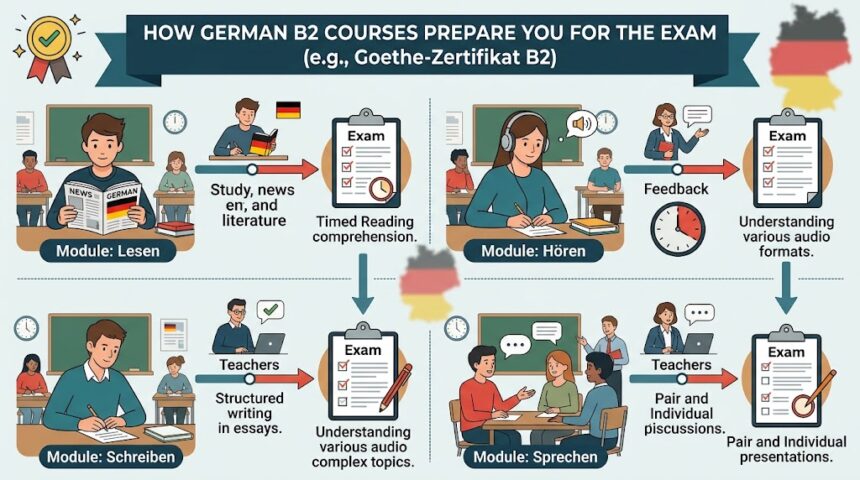
A structured online course can also help organise preparation across the four main language skills:
- reading,
- listening,
- writing,
- speaking.
This is important because a learner may have relatively strong conversational German but still struggle with formal writing or listening tasks. Regular practice across all areas can reveal these weaker points before the examination.
Another benefit is exposure to vocabulary and grammatical structures used in more formal contexts. B2 candidates often need to understand longer texts, express opinions, explain arguments, and participate in discussions. German-based lessons can introduce these skills through presentations, debates, written assignments, and comprehension exercises.
Online courses can also be particularly useful because they allow learners to practise speaking and receive feedback without having to attend a physical language school. Depending on the course, students may participate in live lessons, pair activities, group discussions, or individual sessions with a teacher. These activities can make speaking practice more consistent.
Exam-focused courses also offer familiarity with the examination format. Knowing how tasks are structured, how much time is available, what type of response is expected, and how written or spoken performance is assessed can make preparation more targeted. Practice tests can also help identify areas requiring additional work.
However, the quality of the course matters. A general German course may improve overall language ability but may not provide enough exam-specific practice. For this reason, learners should check whether the online programme includes B2-level materials, mock exams, teacher feedback, and practice for each exam component. A course taught mainly in German can be especially helpful when the learner already has enough foundation to follow the lessons comfortably.