


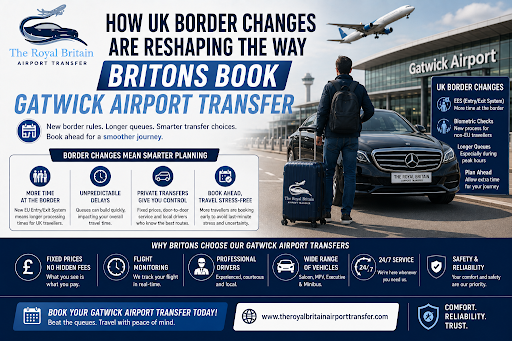
Something has shifted quietly in the way people plan a trip through Gatwick this year. It is not the flight itself that has become less predictable. It is what happens on the other side of it, at passport control in Spain, France, Greece or wherever the plane happens to land. Since the European Union brought its new Entry and Exit System, generally known as EES, into full operation across the Schengen Area on 10 April 2026, British travellers have found themselves spending far longer at the border than they used to, sometimes an hour, sometimes considerably more. None of this changes anything about Gatwick Airport itself. Check in, security and boarding all work exactly as they did before. What has changed is how people now plan every stage of their journey, including how they book Gatwick Airport Transfer. More travellers are choosing to arrange their transport in advance so they can arrive at the airport with confidence, allowing extra time for changing travel requirements and avoiding unnecessary stress before departure.
Why Travel Planning Is Changing
For most of the last decade, flying from Gatwick to a European city meant a passport stamp and little else. That changed when EES began its phased introduction on 12 October 2025, reaching every Schengen border by 10 April 2026. The system replaces manual stamping with a digital record of every entry and exit, and it applies to almost every British passport holder travelling to the Schengen Area for a short stay. Frontex, the European Union’s border agency, has told the travel industry it expects the disruption to continue for another year or two while individual countries catch up on staffing and technology. That is really the detail that matters here. This is not a short lived teething problem. It is a new normal that is likely to shape travel planning for some time yet.
Understanding Recent Border Procedures
EES works by recording a traveller’s fingerprints and a facial scan the first time they cross into the Schengen Area after the rules apply to them, then linking that data to their passport. That first registration typically takes around ninety seconds to a few minutes. Later crossings should move faster, closer to a minute, once the biometric details are already on file. The system also tracks the ninety day allowance within any rolling one hundred and eighty day period that already limits how long British visitors can spend in the Schengen Area, which removes the need for a border officer to count stamps by hand. It is worth being clear about one thing many travellers assume incorrectly. None of this happens at Gatwick. The United Kingdom sits outside the Schengen Area, so the extra checks take place only when a traveller lands in Europe, and again when they leave.
How These Changes Affect Gatwick Travellers
The practical impact lands in two places, and Gatwick is not one of them. Landing in Spain, France or elsewhere in the Schengen Area now often means a longer wait at passport control, particularly for anyone crossing for the first time since the new rules took effect. The bigger concern for most travellers sits on the way home. Airlines have reported passengers missing their return flights after queues to leave the Schengen Area ran longer than expected, with well documented cases in Milan and Toulouse during 2026 involving travellers still standing in line when their flight closed. For someone flying out of Gatwick, that reframes the whole trip slightly. The flight home, not the flight out, has quietly become the leg most worth building extra time around, which has knock on effects for how the return journey from Gatwick itself gets planned, particularly for anyone with a tight connection or an early meeting the next morning.
Why Earlier Journey Planning Matters
Once there is a real chance of delay somewhere in a trip, the sensible response is to remove as much uncertainty as possible from everywhere else. Aviation bodies including ABTA are advising travellers to treat the long standing two hour guidance for European flights as a starting point rather than a comfortable margin, and to build extra time into both ends of a Schengen journey. For anyone flying from Gatwick, that often means paying closer attention to details that used to feel minor, such as confirming which terminal a flight uses, since North and South Terminal at Gatwick are entirely separate buildings connected only by a short shuttle, checking in online in advance where an airline allows it, and increasingly, treating the journey to the airport itself as something worth arranging ahead of time rather than something to sort out on the morning of travel.
Choosing the Right Airport Transport
There is no single right way to reach Gatwick, and it genuinely depends on the traveller. The train remains the fastest option for anyone heading into Central London with light luggage, with Thameslink and Southern Railway services running alongside the dedicated Gatwick Express, and a journey time to Victoria of around half an hour on the fastest services. For a solo traveller with hand luggage only, this is often still the cheapest and simplest choice. Coaches offer a lower cost alternative for those willing to trade speed for savings, particularly on routes beyond Central London. Ride sharing apps can work well off peak, though drivers can decline airport pickups when demand is high, and pricing tends to move with it. Taxis picked up at the rank offer flexibility but no certainty over price until the meter starts running. A private transfer booked ahead of time sits differently to all of these. The price is fixed at the point of booking, the vehicle is assigned in advance, and the journey does not depend on a driver being available on the day. For a single traveller catching an early train with nothing to carry, that certainty is rarely worth paying for. For a family, a group, anyone with heavy luggage, or anyone travelling at an hour when public transport is limited, it usually is. The right choice depends far more on group size, luggage and timing than on any single transport type being universally better.
The Benefits of Booking Transport in Advance
The clearest benefit of arranging transport before the day of travel is that it removes one variable from a journey that, in 2026, already has more of them than usual. A trip that is planned in advance does not depend on finding a taxi at short notice, on parking availability, or on a ride sharing app having a driver nearby. Flight monitoring, where the pickup time adjusts automatically if a flight lands early or late, adds a further layer of certainty that timetabled transport cannot offer. Fixed pricing agreed at the time of booking also makes budgeting for a trip considerably simpler, particularly for a family or group where a shared taxi fare can otherwise become an unwelcome surprise. Providers such as The Royal Britain Airport Transfer, whose Gatwick Airport Transfers service confirms the price at the time of booking and tracks each flight automatically, are built around exactly this kind of certainty. None of this makes booking ahead essential for every traveller. It simply makes it a sensible choice for anyone who would rather remove uncertainty from part of the journey than add to it.
Planning Family Travel
Families face a particular squeeze in 2026, because school holidays already bring Gatwick’s busiest weeks, and the new border checks have added extra unpredictability at the European end during exactly the same period. Children under twelve are exempt from providing fingerprints under EES, although they still pass through the same queues as everyone else, which can test the patience of a tired child on a first crossing. For a family flying from Gatwick, the practical advice has not changed so much as it has been reinforced. Build in more time than feels necessary at both ends of the trip, keep documents somewhere easy to reach rather than buried in a suitcase, and where possible, remove one source of stress from the morning of travel by arranging transport to the airport well in advance.
Business Traveller Considerations
Business travellers tend to work with a narrower margin for error than most, particularly on a same day trip or a tight connection through a busy Schengen hub. A missed return flight because of a longer than expected exit queue carries real costs beyond the ticket itself, including a missed meeting, a rebooking fee and simply lost time. That is part of why predictable, invoiced ground transport at the Gatwick end of a trip has become a more common feature of corporate travel planning this year. It removes one unknown from an itinerary that may already be tighter than it once was, and for a company managing several trips a month, that predictability tends to matter more than the cost of the transfer itself.
Tips for International Travellers
For visitors flying into Gatwick from outside the United Kingdom, the border experience on arrival into Britain is separate from the European system described above and works largely as it always has. The main planning point for international visitors is the return leg into Europe if their itinerary continues there, where the same advice applies as for British travellers. Beyond that, allowing realistic time for London traffic on the M23 and M25, confirming the correct Gatwick terminal against the actual boarding pass rather than assuming, and arranging transport in advance for an unfamiliar city all reduce the chance of an avoidable delay.
Common Mistakes To Avoid
The most common mistake in 2026 is not ignorance of the new border rules, since most travellers have heard of them by now. It is underestimating how they combine with everything else. Treating the old two hour guidance as generous rather than minimal, assuming a same day connection through a Schengen hub still carries low risk, or leaving the journey to Gatwick itself unplanned until the morning of travel are all ways that a manageable delay abroad can turn into a missed flight home. None of these mistakes involve the border checks directly. They involve failing to adjust the rest of the trip to account for them.
Conclusion
The new border checks have not changed anything about Gatwick Airport itself, but they have changed what a well planned journey through it looks like. With Frontex warning that disruption at the border could continue for another year or two, the sensible response is not to worry, but to build a little more margin into every stage of a trip, and to fix the parts of the journey that are genuinely within a traveller’s control, including, for many people, arranging their transport to Gatwick before the day they travel rather than on it.
Frequently Asked Questions
Does the new border system affect check in or security at Gatwick Airport?
No. The checks apply at Schengen borders, not at UK airports. Gatwick’s own check in and security procedures are unchanged. The extra registration happens after landing in Europe, and again on departure from the Schengen Area.
Is the ETIAS travel authorisation in effect yet?
Not as of mid 2026. ETIAS was previously expected in the final quarter of 2026, but the European Union removed that date from its official site in July 2026, and a launch sometime in 2027 is now considered more likely. It is a separate system from EES, which is already fully running.
How much extra time should I allow when flying from Gatwick to a Schengen country?
Travel bodies including ABTA suggest treating the standard two hour guidance for European flights as a minimum rather than a comfortable margin, with additional time recommended during school holidays and at the busier Schengen airports.
Are children required to register under the new system?
Children under twelve do not need to provide fingerprints, although they still move through the same queues as other passengers, so families should not expect the process to be noticeably quicker.
Is the outbound flight or the return flight more likely to be affected?
Based on reports through 2026, delays leaving the Schengen Area have caused more disruption than arrivals, with some travellers missing scheduled flights home after longer than expected exit queues.
Does this affect travel by train or ferry as well as flights?
Yes, the checks apply at Schengen borders regardless of how someone travels. Some rail and ferry terminals in the United Kingdom host French border control on British soil, which is different from flying via Gatwick, where the checks happen only after arrival in Europe.
Is booking a transfer to Gatwick still worthwhile if the delays happen abroad rather than in Britain?
Yes, for a specific reason. Because delays at a European border are outside anyone’s control, removing uncertainty from the parts of the journey that can be controlled, including the trip to the airport, lowers the overall chance of the day going wrong.