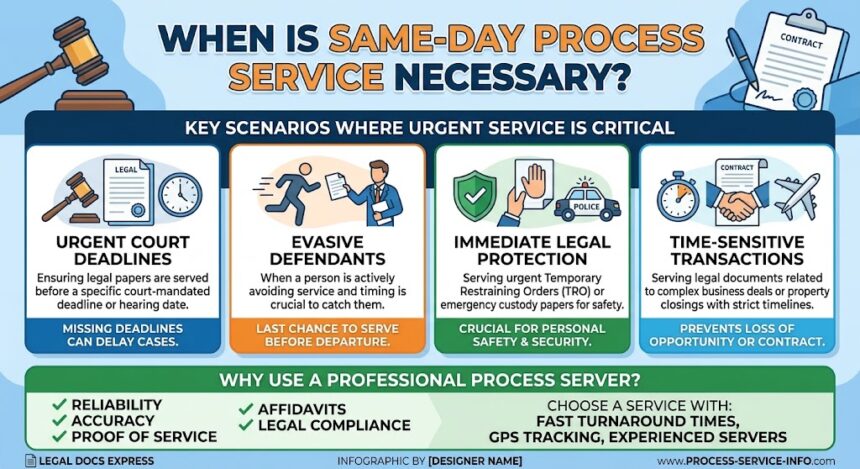
Papers that have sat on a desk for a week can suddenly need to be in someone’s hands by evening. The reason is usually a date on a court calendar rather than anything the sender has done. This article sets out which situations create that pressure, what a same-day instruction can and cannot promise, and what a server needs in hand to move at once.
Situations That Can Create an Urgent Need
Urgency in this work comes from dates that belong to the court rather than to the parties. Missing one can leave too little time for another service attempt or require the party to seek an extension.
Several situations produce that pressure, and these are the ones that recur:
- A service deadline in view. Rule 4(m) of the Federal Rules of Civil Procedure generally gives 90 days after a complaint is filed to serve the defendant. If service is not completed within that period, the court must dismiss the action without prejudice or order that service be made within a specified time, unless the rule’s good-cause provision requires an extension.
- Temporary orders with short lives. A restraining order issued without notice under Rule 65(b) expires within 14 days unless the court extends it, and the hearing on a preliminary injunction is set at the earliest possible time.
- Witnesses who have to be reached. Urgent subpoena service arises where attendance depends on notice, and Rule 45(b)(1) requires the subpoena to be delivered with one day’s attendance fee and mileage tendered at the same time when the subpoena commands attendance.
- Late arrivals and failed attempts. Papers forwarded at the end of a week, or a visit that found an empty address, leave the remaining time to whoever picks the file up next.
What these share is a fixed endpoint. Time-sensitive legal documents can stop being useful once the deadline passes, which is why such requests can become urgent.
Same-Day Attempt vs Same-Day Completion
Two different things are being bought, and the words for them look alike. A same-day service attempt is a visit made to the address on the day of instruction. A same-day completion is delivery accomplished that day by a method the rules allow. A provider controls the first and influences the second.
Urgent process service can be sold as an attempt, whereas a court deadline is satisfied by completion. A promise phrased around the visit, and a promise phrased around the service carry different risks for whoever is holding the calendar.
Several conditions decide which of the two a day produces. None of them are in the server’s hands:
- A recipient at work, away from home, or unwilling to open the door.
- Buildings with controlled access — a gated development, a secured lobby, an office with a reception desk between the visitor and the floor.
- Distance that puts the address beyond the hours left in the day.
Expedited service of process reduces the time available for arranging and carrying out the attempt, while completion still depends on the recipient being available.
Information Needed for Fast Dispatch
Speed on the provider’s side starts with a complete file on the client’s side. A server that has to go back with questions after accepting the work has less time to arrange the attempt.
Three things usually decide how quickly a visit can happen:
- The full documents and the actual deadline. Every page to be served, the case number, and the date the service has to be completed by, stated plainly rather than implied by the word urgent.
- An accurate address with a description of the recipient. The street address with its unit number, together with enough description to identify the person at the door and avoid serving somebody else.
- Schedule, access, and safety notes. Working hours, entry or gate codes where they may lawfully be passed on, and anything about the location that a server should know before arriving.
When all three arrive together, dispatch can follow the call. A same-day process server reaches the road while the file is still being read, whereas the same assignment with half an address spends its first hours on a search, which is the difference when rush process service is planned and priced accordingly.
Costs and Practical Limitations
A rush assignment can cost more because it may require work to be rearranged or handled outside the provider’s normal schedule. Quotes differ between providers, though the elements tend to be the same — a priority fee, travel or mileage, waiting time while a server holds a position, and any attempts beyond the first.
Asking which of those are included and which appear afterward keeps the invoice close to the estimate. A rush process server working evenings or a weekend may also price those hours separately.
Emergency legal document delivery does not change the rules that govern service. Permitted methods, restrictions on time and place, and the proof required afterward still apply, however tight the calendar has become.
That matters more under pressure than at other times. Defective service can be challenged and may have to be redone. A court-deadline service that saves two days but results in a defective return may fail to provide the intended benefit.
How to Avoid Last-Minute Process Service
A good deal of urgency is manufactured upstream, during the weeks when a file looks quiet. Three habits usually reduce how often a firm has to send last-minute process service:
- Calendar the service deadline when the matter opens. Work back from it to the date the instructions have to go out, so the entry holds the window rather than the hearing alone.
- Keep an intake checklist that travels with the file. Documents, address, description, schedule, and access notes gathered once mean the next assignment starts complete.
- Watch the serves that look difficult early. A first attempt that finds nobody home is a signal to act on while time remains.
The point of the three habits is to keep a fast process, serving as the exception that a calendar can absorb.