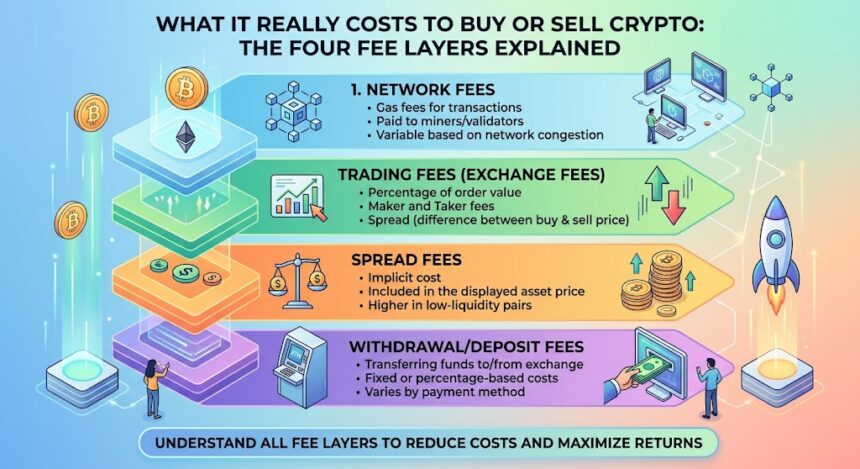
Most crypto platforms advertise a single fee. It is usually a small, tidy percentage, and it is usually the least informative number in the whole transaction.
The real cost of buying or selling crypto is spread across four separate layers. Some are shown clearly, some are buried in the exchange rate, and one changes from minute to minute.
Once you can see all four, comparing platforms becomes far easier.
Layer one: the spread
The spread is the gap between the price at which you can buy and the price at which you can sell at the same moment. If a coin’s mid-market value is £100 and a platform sells it to you at £101 while buying it back at £99, the spread is £2.
Nobody sends you an invoice for the spread. It is baked into the rate, which is why many people never notice it.
Spreads tend to be narrower for popular assets on busy markets and wider on less liquid tokens or during volatile periods. On peer-to-peer marketplaces, individual sellers set their own rates, so the spread is effectively the premium or discount each seller chooses relative to the market price.
Layer two: the platform fee
This is the headline number: a commission, trading fee or service charge taken by the platform for matching or executing your order. It might be a flat percentage, a tiered rate that falls as your volume rises, or a different rate depending on how your order is placed.
Some apps advertise “zero commission” and recover their costs through a wider spread instead. That is not dishonest, but a zero fee can end up costing more than a modest one.
Layer three: the network fee
Every on-chain transaction pays a fee to the blockchain network that processes it. This money does not go to the platform; it goes to the validators or miners who keep the network running.
Network fees vary with congestion and with the chain you use. Moving a stablecoin on one network can cost a fraction of the same transfer on another, and fees on a single network can swing within a day.
You usually meet this layer when you withdraw coins to your own wallet. On marketplaces that use smart-contract escrow, it also appears when the escrow is opened and closed, because both steps are on-chain transactions.
Layer four: the payment fee
The final layer sits outside crypto entirely. It is whatever your bank, card issuer or payment app charges to move pounds in or out.
Card purchases often carry a processing charge, international transfers can involve both a fee and a currency conversion margin, and some e-wallets charge for withdrawals.
UK readers face an extra wrinkle, because several high street banks cap or block payments to crypto exchanges. Santander, for example, limits them to £1,000 per transaction and £3,000 per 30 days, and Chase UK blocks identified crypto payments outright.
An illustrative example
The figures below are invented and clearly labelled as illustrative. They show how the layers stack, not what any real platform charges.
- You start with £1,000 and pay by card. A 1% card charge leaves £990 on the platform.
- The platform takes a 0.5% commission, about £4.95, leaving £985.05 to spend.
- The coin’s mid-market price is £100, but the platform’s buy price is £101. Your £985.05 buys about 9.753 coins, worth roughly £975.30 at the fair price.
- You withdraw to your own wallet and pay a network fee worth about £2.50.
You end up holding roughly £972.80 of crypto. The total cost is about £27.20, or 2.7%, even though the advertised fee was 0.5%.
Sell the same coins later and most of those layers apply again on the way out. If you would rather test your own figures, a free trade fee calculator will do this arithmetic in seconds.
Where the layers hide on different platforms
Each type of platform packages the same four costs differently, which makes quick comparisons misleading.
- Centralised exchanges with order books usually show a low commission, and the spread is visible if you look at the gap between the best bid and the best offer.
- Instant-buy and broker-style apps tend to show one all-in price. That is convenient, but the spread and fee are blended, so compare the final amount rather than any single line.
- Peer-to-peer marketplaces let sellers set their own rates and accepted payment methods. You pay the seller’s rate, a platform fee and, on escrow-based platforms, the network cost of the escrow itself.
Why the headline fee is rarely the full cost
The advertised fee is the only layer a platform fully controls and can present neatly. The spread moves with the market, network fees move with demand on the chain, and payment fees depend on your own bank.
That makes it tempting to market the commission alone. It also means two platforms with identical headline fees can leave you with noticeably different amounts of crypto.
How to compare platforms fairly
The fairest comparison is an all-in one: how much crypto lands in your wallet for a fixed sum in pounds, or how many pounds reach your bank for a fixed amount of crypto.
- Read the fee schedule, not the banner. Look for a published table that separates the platform commission from network costs. Many exchanges publish one, and so do non-custodial marketplaces such as Senpero.
- Check the rate against a reference price. Compare the quoted price with a widely used market price at the same moment to estimate the spread.
- Pick the network deliberately. If a stablecoin is available on several chains, the cheaper network can matter more than the commission on small trades.
- Price your payment method. A bank transfer, a card and an e-wallet can produce three different totals for the same trade.
A quick checklist before you trade
- Note the mid-market price before you look at the platform’s quote.
- Write down the commission, the expected network fee and your payment fee.
- Work out the net amount you will receive, not the gross.
- Remember the round trip: buying now and selling later means paying most layers twice.
- Check your bank’s limits on crypto payments before you start, not halfway through.
Cost is not the only thing that matters when choosing where to trade, since custody, security and a clear dispute process count too. But knowing the true price of a trade is the first step to judging whether it is worth making.