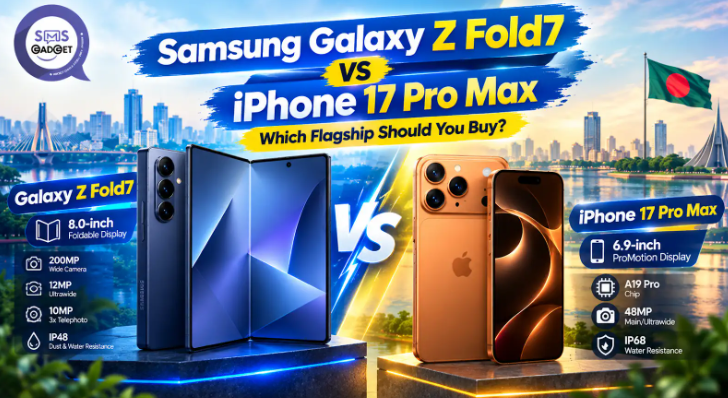
Two phones. Two completely different answers to the same question: what should the best smartphone in the world look like?
Samsung looked at that question and built something that unfolds into a tablet, runs two apps side by side on an 8-inch screen, and makes every other phone feel like it’s thinking too small. Apple looked at the same question and refined every millimeter of a design philosophy that hundreds of millions of people already trust, sharper chip, better camera consistency, titanium frame, and an ecosystem so seamless it feels less like software and more like infrastructure.
Neither answer is wrong. But one of them is right for you, and this comparison exists to find out which one.
Quick Comparison Table
| Feature | Samsung Galaxy Z Fold7 | iPhone 17 Pro Max |
| Display | 8″ main + 6.5″ cover AMOLED | 6.9″ Super Retina XDR OLED |
| Chipset | Snapdragon 8 Elite | A19 Pro |
| Geekbench Multi-core | 9,443 | 9,921 |
| Rear Camera | 200MP main | 48MP triple system |
| Front Camera | 10MP | 18MP |
| Battery | 4,400mAh | 4,832mAh |
| OS | Android 15, One UI 8 | iOS 26 |
| Software Support | 7 years | 6+ years |
| Release Date | July 25, 2025 | September 19, 2025 |
| Form Factor | Foldable | Traditional slab |
Design and Build Quality
-
Samsung Galaxy Z Fold7—Foldable Innovation
The Galaxy Z Fold7 is thinner and lighter than any previous Fold generation, and that matters more than the spec sheet suggests. Every earlier Fold carried a subtle compromise: you knew you were holding a foldable. The Fold 7 narrows that gap significantly. The hinge mechanism has been refined through seven generations of real-world durability feedback, and it shows in how the phone opens and closes—smooth, deliberate, and confidence-inspiring rather than mechanical.
IPX8 water resistance means the foldable form factor no longer requires treating the phone with extra caution around water. For a device this ambitious in design, that’s a meaningful real-world assurance.
The tradeoff is unavoidable: folded, the Fold7 is thicker than a traditional flagship Samsung phone. It fits in a pocket, but it announces itself. Anyone who carries their phone in a shirt pocket will notice.
-
iPhone 17 Pro Max — Titanium Refinement
Apple’s titanium frame on the iPhone 17 Pro Max is not a new idea, it’s an idea that has been executed with increasing precision across two generations. The result is a phone that feels dense and intentional in hand, lighter than its size suggests, and immediately recognizable as a premium object without trying to be one.
The 6.9-inch form factor sits at the edge of one-hand usability for most people. Apple knows this and has optimized iOS 26’s gesture system accordingly, reachability, swipe navigation, and thumb-zone prioritization in native apps make the large screen feel more manageable than the dimensions imply.
-
Which Feels Better in Daily Use?
For a single-device carry that disappears into daily life—the iPhone 17 Pro Max. For a device that changes what daily life looks like on a phone, the Fold7. These are not competing answers. They’re answers to different questions about what “better” means to different people.
Display Comparison
-
Fold7’s Dual-Screen Advantage
The Galaxy Z Fold7’s 8-inch main display is not a gimmick. It is a fundamentally different relationship with content. Reading a document, editing a spreadsheet, watching a video, reviewing photos, and running two messaging apps simultaneously—all of these experiences are qualitatively different on 8 inches than they are on 6.9 inches. The gap is larger than the numbers suggest because screen real estate compounds: twice the space enables workflows that aren’t just faster but categorically different.
The 6.5-inch cover display handles every single-handed, quick-access interaction—notifications, calls, messages, and camera—so the main screen isn’t a requirement for routine tasks. This dual-display architecture means the Fold7 is effectively two phones in one body, with each screen optimized for different interaction modes.
-
iPhone’s Single 6.9-Inch Super Retina XDR
Apple’s Super Retina XDR OLED panel is among the best single displays on any smartphone. Color accuracy, brightness, black levels, and outdoor readability are all class-leading. The 6.9-inch size is large enough to make content consumption genuinely enjoyable without the form factor complexity of a foldable.
For users who don’t want to think about which screen they’re on, which apps support the larger display, or how the hinge will hold up in three years, the iPhone’s single display is a feature, not a limitation.
-
Multitasking vs Simplicity—Which Display Wins?
If you regularly use your phone for productivity, reviewing documents, managing projects, content creation, or research, the Fold7’s main display changes your capability, not just your comfort. If you use your phone primarily for communication, social media, camera, and streaming, the iPhone 17 Pro Max’s display does everything you need with less complexity.
Performance and Chipset
-
A19 Pro vs Snapdragon 8 Elite—The Numbers
The iPhone 17 Pro Max’s A19 Pro posts a Geekbench multi-core score of approximately 9,921. The Galaxy Z Fold7’s Snapdragon 8 Elite comes in at approximately 9,443. The gap is real but narrow—in the range where neither phone will feel faster or slower in any real-world task either device is asked to perform.
What the benchmark doesn’t capture: Apple’s silicon advantage sits in efficiency and sustained performance. The A19 Pro maintains peak performance under sustained load with less thermal throttling than any Android chip currently available. In a traditional slab phone body with standard thermal management, this is the iPhone 17 Pro Max’s advantage. The Fold7’s compressed chassis and the Snapdragon 8 Elite’s thermal management are similarly tested—and Samsung’s engineering team has iterated on this specific challenge across seven Fold generations.
-
Real-World Speed — Apps, Gaming, Multitasking
Both phones handle every app, every game, and every multitasking scenario without hesitation. The performance ceiling of both devices exceeds what any current mobile workload actually requires. Choosing between them on benchmark numbers alone is choosing between two cars because one has a higher top speed, when neither will ever reach that speed on any road you’ll actually drive.
Where the Fold7 genuinely differentiates in real-world performance is multitasking architecture. Running three apps in split view on an 8-inch display while the Snapdragon 8 Elite manages the processing demands of each, this is a use case where the Fold7’s performance serves a capability the iPhone cannot replicate regardless of its benchmark advantage.
-
Software Experience — iOS 26 vs One UI 8
iOS 26 continues Apple’s philosophy of depth over breadth, fewer customization options, higher polish on every interaction, and Apple Intelligence features (writing tools, image generation, and Siri’s contextual awareness improvements) that are deeply integrated rather than bolted on.
One UI 8 on the Fold 7 brings a foldable-optimized interface that has matured significantly since the first Fold. Taskbar persistence, flex mode for hands-free video calls and camera use, multi-window drag and drop, and DeX mode for desktop-like external display use all represent genuine productivity additions that iOS 26 does not offer equivalents for. Samsung’s Galaxy AI features, live translation, note summarization, and circle to search complement the larger display in ways that feel purposeful rather than feature-list padding.
For software support longevity, Samsung commits to 7 years of OS updates for the Z Fold7. Apple’s track record suggests 6+ years for the iPhone 17 Pro Max. Both represent the best software longevity commitments in their respective ecosystems.
Camera Showdown
-
Rear Camera — 200MP Samsung vs 48MP Triple System iPhone
The 200MP headline on the Galaxy Z Fold 7 will win every spec sheet comparison. It will not automatically win every photo comparison—and understanding why matters more than the megapixel gap.
Megapixels measure resolution, not image quality. The 200MP sensor on the Fold7 produces exceptional detail in optimal conditions and enables significant digital zoom cropping while retaining usable resolution. In controlled daylight, the detail capture is genuinely impressive.
Apple’s 48MP triple camera system on the iPhone 17 Pro Max prioritizes different qualities: color science that requires minimal post-processing, computational photography that handles challenging lighting consistently, and video capabilities—specifically ProRes video recording and the Cinematic Mode depth-of-field system, that have become production standards for professional content creators.
The honest camera verdict: the Fold7’s 200MP sensor captures more data in good light. The iPhone 17 Pro Max’s camera system produces more reliable results across more varied conditions with less effort from the user.
-
Front Camera and Video Calling
The iPhone 17 Pro Max’s 18 MP front camera is the stronger selfie system—higher resolution, better dynamic range, and Apple’s computational portrait processing produce consistently better front-facing results. For users whose front-camera use is significant—content creators, video callers, and social media users—this gap is real.
The Fold7’s 10MP front camera performs adequately for video calls and casual selfies. It is not a selling point of the device.
-
Real Photo Quality — Not Just Megapixels
A content creator shooting travel photography needs reliable results in unpredictable lighting across a full day. The iPhone 17 Pro Max delivers that consistency — a photo taken in a dim restaurant, a harsh midday outdoor scene, and a golden hour landscape will all produce usable results with minimal adjustment. The flagship Samsung phone, Fold7, excels when conditions are favorable, and the photographer has time to work with the image. When conditions are unpredictable and speed matters, the iPhone’s camera system makes fewer mistakes.
For video specifically, if professional video output matters—short films, YouTube content, client work—the iPhone 17 Pro Max remains the industry’s reference point. ProRes LOG recording, the most advanced video stabilization on any smartphone, and Apple’s color science that matches professional post-production workflows give it an advantage that 200MP cannot address because video quality and photo resolution are separate technical dimensions.
Battery Life and Charging
-
Battery Capacity Compared
The iPhone 17 Pro Max carries approximately 4,832mAh. The Galaxy Z Fold7 carries approximately 4,400mAh. On paper, the iPhone wins on capacity. In real-world use, the Fold7’s larger display — particularly when the 8-inch main screen is in use — consumes power at a rate that the capacity difference doesn’t offset.
Both phones will get most moderate users through a full day. Heavy Fold7 users who spend significant time on the main display should expect to charge before the end of the day under sustained use.
-
Charging Speed and Wireless Charging
This is where Samsung pulls ahead clearly. The Galaxy Z Fold7 supports 25W wired charging and 15W wireless, faster than Apple’s offering. The iPhone 17 Pro Max supports MagSafe wireless charging and wired charging, but Apple’s charging speed ceiling remains more conservative than Samsung’s. For users who charge quickly between tasks—at a desk, in a car, before heading out, Samsung’s charging architecture is more convenient.
-
Real-World Battery Life
For a moderate user, calls, messaging, social media, camera, and streaming, both phones survive a full day comfortably. The iPhone 17 Pro Max’s battery efficiency advantage from the A19 Pro’s power management means it handles that moderate day with more reserve remaining at bedtime.
For a power user working on the Fold7’s main display throughout the workday—documents, emails, video calls, multitasking—expect to charge by mid-afternoon under heavy use, or carry a charger as a routine rather than an emergency measure.
Software and Ecosystem
-
iOS vs One UI—Which Ecosystem Fits You?
This question has a simple heuristic: what other devices do you own?
iPhone users who also use a MacBook, iPad, Apple Watch, or AirPods live inside an ecosystem where everything connects without configuration. Universal Clipboard, Handoff, AirDrop, iMessage on all devices, and Apple Watch unlock from a Mac all work because Apple controls every layer. Switching to Android means losing all of it.
Samsung mobile users in the Galaxy ecosystem—Galaxy Watch, Galaxy Buds, and Galaxy Tab, get a comparable integration story on the Android side, with the addition of DeX for desktop use and Link to Windows for PC integration that iOS cannot match. Samsung’s ecosystem is more open, it works with Windows, MacOS, and third-party devices in ways iOS doesn’t, but less seamless at the interaction level than Apple’s closed integration.
-
App Optimization for Foldables
This is the gap most competitor articles ignore entirely: not all apps take advantage of the Fold7’s 8-inch display. Major productivity apps—Google Workspace, Microsoft 365, Samsung Notes—are fully optimized for the larger canvas. Social media apps and many third-party applications still render as scaled phone layouts rather than true tablet interfaces.
This is improving with every One UI release, and Samsung’s developer relations push has accelerated optimization across key apps. But buyers should know that the 8-inch display experience varies by app — some feel purpose-built for the larger screen, others feel like a phone app that got bigger.
-
Long-Term Software Support
Both devices offer among the longest software support windows in the industry. Samsung’s 7-year commitment for the Fold7 and Apple’s consistent 6+ year history for iPhone 17 Pro Max both mean the phone you buy today remains current and secure well into the next decade. For buyers who keep phones for 3–4 years, both commitments more than cover the ownership period.
Price and Value for Money
Starting Prices and Storage Tiers
Both devices launch at premium price points, the Galaxy Z Fold7 commands a foldable premium above standard flagship pricing, and the iPhone 17 Pro Max sits at the top of Apple’s lineup. In Bangladesh, both represent significant investments. For current verified pricing in the local market, checking the latest Samsung mobile price in Bangladesh gives accurate figures before any purchase decision.
Which Offers Better Long-Term Value?
Resale value: iPhone holds resale value more consistently than Samsung flagships in Bangladesh’s secondhand market. A 2-year-old iPhone 17 Pro Max will command a higher percentage of its original price than a 2-year-old Galaxy Z Fold7 in most market conditions.
Repair costs: The Fold7’s inner display replacement is the most expensive repair scenario on any mainstream smartphone, the foldable screen is both delicate and costly to replace. The iPhone 17 Pro Max’s repair costs are high but more predictable and more widely serviceable.
Foldable durability: The Fold7’s hinge and inner display are the two points of mechanical vulnerability that a traditional phone doesn’t have. Samsung has improved both significantly across generations, but they remain the honest durability consideration for anyone evaluating a 3-year ownership horizon.
For buyers in Bangladesh comparing the full Samsung lineup alongside both devices, the authorized Samsung Mobile Shop range provides context on where the Fold7 sits against Samsung’s own flagship alternatives.
Who Should Buy the Galaxy Z Fold7?
- Multitaskers who run multiple apps simultaneously and want a phone that genuinely changes how much they can accomplish on a screen
- Content creators who review footage, edit documents, and manage social platforms from their phone and want a larger canvas
- Tech early adopters who want the most ambitious form factor available and are comfortable with foldable-specific considerations
- Professionals who travel frequently and want a phone-plus-tablet in one device without carrying two screens
- Android ecosystem users already invested in Samsung’s Galaxy ecosystem who want to stay within it at the highest tier
- Productivity-first buyers whose daily phone use looks more like a laptop workflow than a consumption workflow
Who Should Buy the iPhone 17 Pro Max?
- Apple ecosystem users with MacBook, iPad, Apple Watch, or AirPods who want seamless cross-device integration
- Camera-focused buyers who prioritize consistent, reliable photo and video results across all lighting conditions without extensive editing
- Video creators who need ProRes recording and professional-grade stabilization for client work or YouTube production
- Simplicity seekers who want a phone that is excellent at everything without complexity or learning curve
- One-handed use prioritizers for whom the Fold7’s folded thickness and weight is a daily friction point
- Resale-conscious buyers who plan to upgrade in 2–3 years and want strong value retention
Frequently Asked Questions
Is the Galaxy Z Fold 7 more durable than previous Fold models?
Significantly. Seven generations of hinge engineering have produced a mechanism that opens and closes with noticeably less mechanical resistance and a more consistent feel than earlier Fold devices. IPX8 water resistance means liquid exposure is no longer the automatic death sentence it was for first- and second-generation foldables. The inner display remains the most vulnerable component, it’s more durable than any previous Fold, but it requires more care than a traditional glass front.
Does the iPhone 17 Pro Max support expandable storage?
No. Apple does not offer expandable storage on any iPhone. The iPhone 17 Pro Max is available in fixed storage configurations. For buyers who need significant local storage for video production, offline media, or large file management, this is worth factoring into which storage tier to purchase at the outset—there’s no adding more later.
Which phone has a better camera for low light?
The iPhone 17 Pro Max produces more consistent low-light results across varied conditions. Apple’s computational photography and sensor calibration handle the unpredictability of low-light environments, mixed artificial lighting, very dark venues, and fast-moving subjects in dim conditions, with fewer failures than the Fold7’s 200MP system, which performs better when conditions are more controlled. For dedicated low-light photography with time to work the shot, the gap narrows. For spontaneous low-light moments, the iPhone is more reliable.
Is the Fold 7 worth the extra bulk over a regular flagship?
For the right buyer, unquestionably. The “bulk” of the Fold7 is the price of carrying an 8-inch display in a pocket, and whether that trade-off makes sense depends entirely on how much of your daily phone use would benefit from that extra screen. For a content creator, a project manager, or a heavy multitasker, the Fold7’s dimensions are not bulk, they’re capability. For a buyer whose primary use is communication, social media, and camera, the additional thickness and weight serve a screen they won’t use enough to justify the form factor difference.
Final Verdict — Which Flagship Wins?
There is no universal winner here, and that’s not a hedge. These two phones don’t compete for the same buyer. They represent two completely different answers to what a flagship smartphone should be in 2026.
Choose the Samsung Galaxy Z Fold7 if your phone is where your work actually happens. The 8-inch display isn’t a novelty, it’s a workspace. Split-view multitasking, foldable-optimized apps, and One UI 8’s productivity architecture give the Fold7 capabilities no traditional slab phone can replicate, regardless of chip speed or camera resolution. If you open your phone to get things done, the Fold7 will change what “getting things done” looks like.
Choose the iPhone 17 Pro Max if what you need most is a phone that does everything it promises, every single time, without asking anything of you in return. The camera is consistent across lighting conditions. The ecosystem connects every Apple device you own without setup. The resale value holds longer than almost any Android alternative. And the experience — from the first unlock to three years later — stays refined, predictable, and trustworthy in a way that requires no learning curve and makes no apologies.
The simplest way to decide: if you want your phone to expand what’s possible, buy the Fold7. If you want your phone to perfect what’s already essential, buy the iPhone 17 Pro Max.
Both are worth every taka at the right hands. The question is which pair of hands you have.