


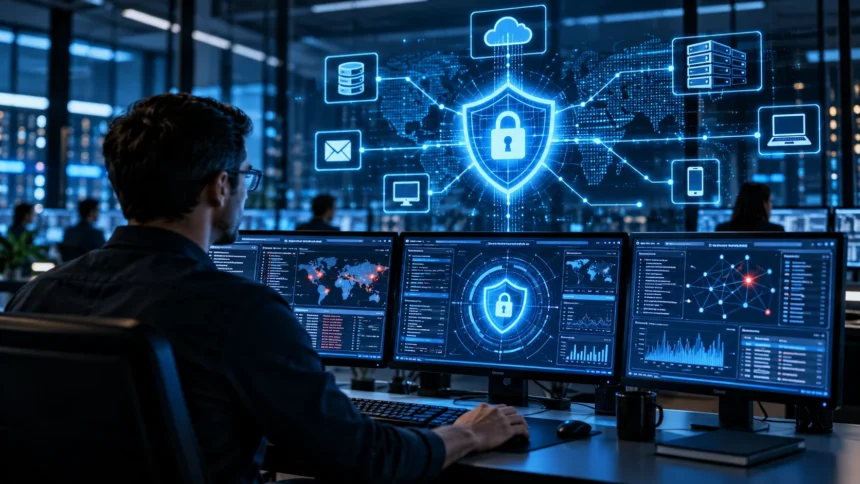
Cybersecurity plays an essential role in protecting computers, networks, applications, and sensitive information from digital threats. As businesses and individuals increasingly depend on the internet, the risk of unauthorized access, data breaches, and cyberattacks continues to grow. Understanding how cybersecurity works helps explain the technologies and security practices used to keep digital information protected.
Cybersecurity works by combining multiple layers of protection that prevent unauthorized access, detect suspicious activities, and respond to potential security incidents. These protective measures include firewalls, encryption, authentication systems, security monitoring tools, and regular software updates. Each technology performs a specific function while contributing to a broader security strategy.
Effective cybersecurity also requires human awareness, organizational policies, and continuous risk management. No single security tool can prevent every possible threat. This guide explains how cybersecurity works, the main security principles, common protective technologies, threat detection methods, and practical steps for maintaining safer digital environments.
What Is Cybersecurity?
Cybersecurity is the practice of protecting computer systems, digital networks, applications, and information from unauthorized access, damage, disruption, and theft. It combines technologies, processes, and security policies designed to reduce digital risks. Its primary objective is to maintain the confidentiality, integrity, and availability of information while ensuring that essential systems remain reliable.
Cybersecurity applies to personal devices, business networks, cloud platforms, government infrastructure, and online services. For example, banks use security systems to protect customer information and financial transactions. Businesses implement access controls and network monitoring to protect internal resources. Individuals rely on passwords, software updates, and account security measures to protect personal information.
Cybersecurity is not limited to installing antivirus software or creating strong passwords. It involves identifying potential threats, evaluating vulnerabilities, implementing safeguards, and responding to security incidents. Since technologies and cyber threats continually evolve, protective measures require regular improvement. This ongoing process helps organizations maintain more secure and dependable digital operations.
How Does Cybersecurity Work?
Cybersecurity works through a combination of preventive controls, monitoring technologies, and incident response procedures. Preventive measures attempt to stop unauthorized activity before it causes damage. Detection systems identify suspicious behavior that may indicate a security problem. Response procedures help organizations contain incidents and restore affected services when protection measures fail.
A typical cybersecurity system uses multiple security technologies working together. Firewalls regulate network communication, encryption protects sensitive information, and authentication systems verify user identities. Security monitoring tools examine activity for possible threats. Regular updates and vulnerability management help address weaknesses that attackers might otherwise exploit.
Cybersecurity also depends on clear responsibilities and informed users. Employees must recognize suspicious messages, protect credentials, and follow security policies. Security teams investigate alerts, maintain protective systems, and assess emerging risks. Combining technical controls with responsible behavior creates stronger protection than relying on individual security products alone.
The Three Main Principles of Cybersecurity
Cybersecurity is commonly explained through three fundamental principles known as the CIA triad. These principles are confidentiality, integrity, and availability. They describe the essential requirements for protecting information and maintaining reliable systems. Organizations use this framework when evaluating cybersecurity risks and designing appropriate security controls.
Confidentiality means ensuring that sensitive information is accessible only to authorized individuals. Integrity focuses on keeping information accurate and preventing unauthorized changes. Availability ensures that systems and data remain accessible when legitimate users need them. These principles support different aspects of security but are closely connected.
For example, an online banking platform must prevent unauthorized users from viewing private account information. It must also ensure that transaction records remain accurate and that customers can access services when needed. Encryption supports confidentiality, validation mechanisms protect integrity, and reliable infrastructure improves availability. Effective cybersecurity balances all three objectives.
How Cybersecurity Protects Computer Networks
Network security is an important component of cybersecurity because computers and devices frequently communicate through connected systems. Networks transfer information between employees, servers, applications, and external services. Without appropriate safeguards, unauthorized users may attempt to access sensitive resources. Network security measures help regulate communication and identify suspicious activity.
Firewalls, network segmentation, access controls, and intrusion detection systems are commonly used to protect networks. Firewalls evaluate traffic according to defined rules, while segmentation separates systems into controlled groups. Monitoring technologies examine network activity for unusual behavior. These controls reduce unnecessary exposure and help security teams recognize potential threats.
Network protection also requires ongoing maintenance and configuration reviews. Outdated network devices or incorrectly configured permissions can create security weaknesses. Organizations should regularly evaluate their network architecture and restrict unnecessary access. Combining technical monitoring with secure configurations supports reliable communication and stronger protection against cyber threats.
How Firewalls Work in Cybersecurity
A firewall is a security technology that monitors and controls network traffic according to established rules. It acts as a protective boundary between different networks or systems. Firewalls can restrict unwanted connections while allowing approved communication. They are commonly used in business networks, personal computers, and cloud environments.
Firewalls evaluate information about network connections, such as addresses, ports, protocols, and connection states. More advanced firewalls may also inspect application traffic and identify certain suspicious patterns. The exact capabilities depend on the firewall’s design and configuration. Proper rules help organizations control which services can communicate with protected resources.
Although firewalls provide important protection, they cannot prevent every cyberattack. Threats may originate from authorized connections, compromised accounts, or malicious software already present inside a network. Firewalls therefore work best alongside authentication, endpoint protection, monitoring, and secure software configurations. Their effectiveness also depends on regular maintenance and appropriate security policies.
How Encryption Protects Sensitive Data
Encryption protects information by converting readable data into an encoded form that requires an appropriate key to interpret. This process helps prevent unauthorized individuals from understanding sensitive information. Encryption is widely used in online banking, secure messaging, cloud storage, and digital communications. It supports confidentiality when information is stored or transmitted.
Two major encryption approaches are symmetric and asymmetric encryption. Symmetric encryption uses the same secret key for encryption and decryption. Asymmetric encryption uses a related public and private key pair for particular cryptographic operations. These methods serve different purposes and are often combined within modern security protocols.
Encryption is effective only when implemented and managed correctly. Weak configurations, exposed cryptographic keys, or compromised user accounts can undermine security. Encryption also does not automatically prevent information from being altered, deleted, or accessed through legitimate but compromised accounts. Organizations combine encryption with access controls and other protective measures to address these risks.
How Authentication and Authorization Work
Authentication and authorization are essential cybersecurity processes that control access to digital systems. Authentication verifies whether someone is who they claim to be. Authorization determines which information or functions that verified user can access. These processes help protect sensitive resources from unauthorized activity and unnecessary exposure.
Passwords are a common authentication method, but many organizations use additional verification mechanisms. Multifactor authentication combines two or more independent factors, such as a password and a security key. This makes unauthorized access more difficult when a password becomes compromised. The effectiveness of authentication depends on the strength and correct implementation of the chosen methods.
Authorization follows authentication by assigning appropriate permissions to users and applications. For example, an employee may be allowed to view certain business records without permission to modify them. The principle of least privilege limits access to what is necessary for legitimate responsibilities. Regular permission reviews help prevent excessive access and reduce security risks.
How Antivirus and Endpoint Security Work
Endpoint security protects devices such as laptops, desktop computers, smartphones, and servers from digital threats. These devices frequently access business networks and sensitive information. Because users interact directly with endpoints, they can become targets for malware and unauthorized activity. Endpoint protection technologies help identify suspicious behavior and reduce exposure.
Traditional antivirus software identifies certain malicious programs through recognizable characteristics. Modern endpoint security solutions may also use behavioral monitoring, reputation analysis, and other detection techniques. These systems can alert users or administrators when potentially harmful activity occurs. Some products also support isolation and investigation of affected devices.
Endpoint protection requires more than security software alone. Devices should receive operating system updates, secure configurations, and appropriate access restrictions. Organizations may use centralized management platforms to apply policies consistently. Combining these measures helps protect individual devices while supporting the security of the wider network.
How Cybersecurity Detects Threats
Threat detection involves identifying activities that may indicate unauthorized access, malware, or other security incidents. Cybersecurity systems collect information from networks, applications, devices, and user accounts. Monitoring tools analyze these records to identify unusual patterns or known indicators of malicious activity. Suspicious events can then be investigated by security professionals.
Security Information and Event Management systems, commonly called SIEM platforms, help organize and analyze security-related information. These platforms collect logs from different sources and identify events that may require attention. Intrusion detection systems also examine network or system activity. Their alerts provide useful information but do not always confirm that an attack has occurred.
Threat detection systems can produce false positives, meaning legitimate activity is incorrectly identified as suspicious. They may also miss certain threats if available information is incomplete. Security analysts therefore evaluate alerts using context and additional evidence. Combining automated detection with human investigation improves the reliability of security decisions.
How Cybersecurity Prevents Malware Attacks
Malware is software designed to disrupt systems, steal information, or perform other unauthorized activities. Common categories include viruses, worms, trojans, spyware, and ransomware. Different malware types behave differently, but they can all create risks for computer systems and sensitive information. Cybersecurity measures attempt to prevent infections and identify harmful activity.
Malware prevention commonly involves endpoint security, software updates, access controls, and safe application management. Keeping operating systems and applications updated helps address known vulnerabilities. Restricting unnecessary permissions can also reduce the potential impact of malicious programs. Security awareness training helps users recognize suspicious files, links, and downloads.
Organizations also maintain backups and incident response procedures to support recovery after malware-related disruptions. Reliable backups help restore important information when systems become unavailable. However, backup systems must be protected and tested regularly. A layered approach combining prevention, detection, and recovery provides stronger protection than depending on antivirus software alone.
How Cybersecurity Protects Against Phishing
Phishing is a social engineering technique that attempts to deceive people into sharing sensitive information or taking unsafe actions. Attackers may impersonate trusted companies, colleagues, or service providers through email, messages, and websites. Their objective is often to obtain passwords, financial details, or unauthorized account access. Cybersecurity protection addresses both technical and human vulnerabilities.
Email security systems can identify some suspicious messages using filtering rules, sender authentication checks, and threat analysis. Web protection tools may also warn users about known deceptive websites. However, sophisticated phishing messages can sometimes bypass automated controls. Human judgment remains important when evaluating unexpected requests and unfamiliar communication.
Security awareness training teaches users to recognize warning signs such as unusual urgency, unexpected attachments, and requests for confidential information. Multifactor authentication can reduce the consequences of stolen passwords. Organizations should also maintain clear reporting procedures for suspicious messages. These combined measures help reduce phishing risks without assuming that any single defense is completely reliable.
How Cloud Cybersecurity Works
Cloud cybersecurity protects information, applications, and computing resources hosted on cloud platforms. Organizations use cloud services for storage, software applications, databases, and infrastructure. Although cloud providers maintain certain security controls, customers also have responsibilities. Understanding these shared responsibilities is essential for protecting cloud environments.
Common cloud security measures include identity management, encryption, access controls, logging, and secure configuration. Organizations must determine which users and applications can access particular resources. Incorrect permissions or publicly exposed storage can create security vulnerabilities. Monitoring and configuration reviews help identify weaknesses before they lead to serious incidents.
Cloud security also requires attention to data protection and service availability. Backup procedures, access restrictions, and incident response planning remain important. Responsibilities vary depending on whether an organization uses infrastructure, platform, or software services. Effective cloud cybersecurity involves understanding the provider’s controls and managing the security tasks assigned to the customer.
How Application Security Works
Application security focuses on protecting software from vulnerabilities and unauthorized activity throughout its lifecycle. Websites, mobile applications, and business programs frequently process sensitive information. Poorly designed security controls can expose data or allow unintended actions. Application security practices help reduce these risks during development, testing, and maintenance.
Developers use secure coding techniques, input validation, authentication controls, and security testing to improve application protection. Code reviews can identify weaknesses before software is released. Automated scanning tools may also detect certain known vulnerabilities. These measures are most effective when security is considered throughout the software development process.
Application security continues after deployment because new vulnerabilities can emerge over time. Developers must monitor software components, maintain updates, and respond to reported weaknesses. Security teams may also evaluate application behavior and access patterns. Combining secure development practices with ongoing maintenance helps protect software and the people who depend on it.
How Cybersecurity Uses Artificial Intelligence
Artificial intelligence is increasingly used in cybersecurity to analyze large amounts of information and support threat detection. Machine learning systems can identify patterns that differ from expected behavior. These technologies help security teams review logs, organize alerts, and prioritize potential incidents. Their usefulness depends on reliable data and appropriate evaluation.
AI-assisted security tools may help recognize unusual account activity, suspicious network behavior, or potentially harmful software patterns. They can process information more quickly than manual analysis in certain situations. However, automated systems may generate incorrect alerts or overlook unfamiliar threats. Human professionals remain necessary for interpreting results and making important security decisions.
Artificial intelligence also introduces additional cybersecurity concerns because AI applications require protection. Models, datasets, and supporting infrastructure can face unauthorized access or manipulation. Organizations must consider the security of AI systems alongside their benefits. Combining automation with appropriate oversight helps maintain reliable cybersecurity operations.
How Cybersecurity Risk Management Works
Cybersecurity risk management is the process of identifying, evaluating, and addressing threats that could affect digital systems and information. Organizations cannot eliminate every possible security risk. Instead, they determine which assets require protection and which threats could cause the greatest harm. This approach helps prioritize security resources and protective measures.
A risk assessment generally examines important information, possible threats, existing vulnerabilities, and the effectiveness of security controls. For example, a business may identify customer records as sensitive and evaluate how unauthorized access could occur. Security teams then recommend measures appropriate to the identified risks. These may include stronger authentication, encryption, or monitoring.
Risk management is an ongoing process because business operations and technology environments change. Organizations should periodically review their assessments and evaluate newly discovered vulnerabilities. Security decisions must also consider operational requirements and available resources. A structured approach supports more consistent cybersecurity planning and informed risk reduction.
How Cybersecurity Incident Response Works
Incident response involves identifying, investigating, containing, and recovering from cybersecurity incidents. These incidents may include malware infections, unauthorized account access, data breaches, or service disruptions. A clear response process helps organizations reduce confusion and coordinate important decisions. Preparation is essential because security problems can occur unexpectedly.
A typical incident response process includes preparation, detection, analysis, containment, recovery, and lessons learned. Security teams first determine what happened and which systems may be affected. They then take appropriate steps to limit further damage and restore normal operations. Documentation helps organizations understand the incident and evaluate their response.
After an incident, organizations review the causes and identify opportunities for improvement. They may update security controls, revise policies, or provide additional training. Recovery plans and backup procedures are also evaluated. Learning from previous incidents helps strengthen future cybersecurity protection and organizational preparedness.
How Cybersecurity Protects Businesses
Businesses rely on cybersecurity to protect customer information, financial records, intellectual property, and operational systems. A security incident can interrupt services, expose confidential information, and create financial or legal consequences. Effective cybersecurity reduces these risks through coordinated protective measures. It also supports business continuity and customer confidence.
Business cybersecurity commonly includes employee training, network protection, secure applications, access management, and incident response planning. Organizations may establish dedicated security teams or work with external specialists. Regular security assessments help identify weaknesses and evaluate existing controls. These activities support more consistent protection across departments.
Cybersecurity responsibilities also extend to third-party services and suppliers. Businesses frequently depend on external software, cloud platforms, and technology providers. Weaknesses in these relationships can affect organizational security. Reviewing vendor risks and maintaining clear security expectations helps reduce exposure across connected business environments.
How Individuals Can Improve Cybersecurity
Individuals can improve cybersecurity by developing simple and consistent digital safety habits. Using unique passwords, enabling multifactor authentication, and installing software updates are important protective measures. These actions help reduce the likelihood of unauthorized access. They are especially valuable for personal email, financial services, and other important online accounts.
People should also remain cautious when downloading files, opening unexpected attachments, or visiting unfamiliar websites. Suspicious messages may attempt to steal information or redirect users to deceptive services. Verifying requests through trusted channels helps reduce phishing risks. Keeping personal devices protected with supported security software provides another layer of defense.
Regular backups can help individuals recover important files after device failures or security incidents. Users should also review account permissions and remove access that is no longer necessary. Securing smartphones and computers with appropriate screen locks adds further protection. These practices work together to reduce common digital risks.
Why Cybersecurity Requires Continuous Monitoring
Cybersecurity is not a one-time activity because digital systems and threats change continuously. New software vulnerabilities may appear, user accounts may become compromised, and organizational requirements can evolve. Protective controls that were effective previously may need adjustments. Continuous monitoring helps identify changes that could affect system security.
Security teams monitor network activity, system logs, endpoint behavior, and access patterns. Automated tools can highlight suspicious events and notify appropriate personnel. Regular vulnerability assessments and configuration reviews also support ongoing protection. These activities help organizations identify potential weaknesses before they develop into more serious problems.
Monitoring alone does not guarantee complete security. Organizations must also investigate alerts, maintain accurate records, and improve protective measures when necessary. Effective cybersecurity depends on combining visibility with timely action. Continuous evaluation helps security programs remain relevant as technologies and risks evolve.
Conclusion
Cybersecurity works by combining technologies, policies, and security practices that protect digital systems and information. Firewalls regulate network communication, encryption protects sensitive data, and authentication controls restrict unauthorized access. Monitoring tools identify suspicious activities, while incident response procedures support recovery when problems occur. Together, these components form a layered security approach.
Effective cybersecurity also depends on human awareness and responsible system management. Strong passwords, multifactor authentication, software updates, and regular backups help reduce common risks. Businesses require additional measures such as risk assessments, employee training, and security monitoring. No single tool can prevent every possible cyber threat.
Understanding how cybersecurity works provides a foundation for safer digital activities and more informed technology decisions. As cyber threats and computing environments evolve, security practices must continue adapting. Combining prevention, detection, response, and recovery helps individuals and organizations maintain stronger protection against digital risks.
Frequently Asked Questions
How Does Cybersecurity Work in Simple Terms?
Cybersecurity works by using technologies and security practices to protect computers, networks, and information. It prevents unauthorized access, detects suspicious activities, and helps organizations respond to digital security incidents.
What Are the Main Components of Cybersecurity?
The main components include network security, endpoint protection, application security, cloud security, identity management, and incident response. These areas work together to protect digital systems and sensitive information.
How Do Firewalls Help Cybersecurity?
Firewalls monitor and control network traffic according to defined security rules. They help restrict unauthorized connections and protect systems from certain network threats, although additional security measures are still necessary.
Can Cybersecurity Prevent All Cyberattacks?
No cybersecurity system can prevent every possible attack. However, strong security controls, continuous monitoring, employee awareness, and effective incident response can significantly reduce risks and limit potential damage.
How Can Beginners Learn How Cybersecurity Works?
Beginners can start by studying computer fundamentals, networking, operating systems, and common cyber threats. Learning about firewalls, encryption, authentication, and security monitoring provides a useful foundation for further study.