

Introduction to Note-Taking
Note-taking is an essential academic skill that involves recording information from lectures, texts, and discussions in a structured manner. For students, effective note-taking serves as a pivotal strategy for enhancing learning and improving retention of information. When students consciously engage in the process of capturing key concepts and details, they actively participate in their learning; this not only fosters understanding but also aids memory consolidation.
Research indicates that the act of writing notes helps encode information into long-term memory, and thus, can significantly impact a student’s overall academic performance. By employing various note-taking methods, students can tailor their approach to fit their individual learning styles and objectives, leading to more effective study habits. Whether it’s through the Cornell Method, mind mapping, or outlining, each technique has unique advantages that can cater to different subjects and disciplines.
Additionally, organized notes can serve as valuable study aids, enabling students to review and summarize complex topics succinctly. This is particularly beneficial during exam preparation, as well-structured notes allow for quicker revisions and better information recall. Furthermore, effective note-taking also cultivates critical thinking skills and promotes engagement with the material, encouraging students to analyze and synthesize information rather than passively receiving it.
In a rapidly evolving educational landscape that prioritizes information literacy and independent learning, mastering the art of note-taking is more important than ever. By employing effective note-taking methods, students equip themselves with tools that not only facilitate academic success but also support lifelong learning.
The Importance of Effective Note-Taking
Effective note-taking is an essential skill that significantly impacts students’ academic performance. By capturing salient points during lectures or while reading, students can enhance their comprehension and retention of material. Notably, research shows that students who engage in active note-taking not only understand concepts faster but also absorb them more deeply compared to those who passively listen or read without organization.
Organized notes serve as a valuable resource, enabling individuals to revisit and review key information efficiently. According to a study by the Stanford University Institute for Higher Education Research, students who utilize structured notes outperform their peers by 15% in recall tests. This correlation underscores the necessity of good note-taking practices not just for immediate understanding but for long-term academic success.
Another critical benefit of effective note-taking is its role in exam preparation. Well-organized notes act as a personalized study guide, significantly reducing the time and effort needed to gather information before tests. The American Educational Research Association found that students who reported using effective note-taking strategies were more likely to achieve higher grades compared to those who did not. Specifically, 65% of high achievers attributed their success to systematic note-taking techniques.
Furthermore, good notes can help students synthesize and connect ideas from different subjects, leading to a more holistic understanding of the coursework. This interconnected knowledge is vital for tackling interdisciplinary problems and academic discussions, thus preparing students for real-world applications of their studies.
Traditional Note-Taking Methods
Traditional note-taking methods provide students with structured approaches to record and organize information during lectures or study sessions. Among the most recognized techniques are the Cornell Method, the Outline Method, and the Charting Method, each with its distinct advantages and ideal use cases.
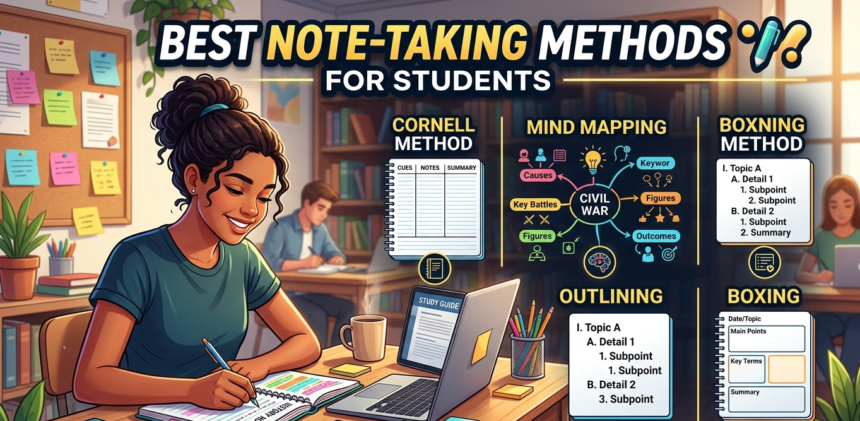
The Cornell Method divides the page into three sections: cues, notes, and summary. Students jot down main notes in the right-hand column during the lecture. Afterward, keywords or questions are noted in the left column, helping to facilitate review. This method is particularly useful for subjects that require comprehension of complex theories, as it promotes active engagement with the material. However, one drawback is that it demands proper formatting and might need some practice to master.
Next, the Outline Method utilizes a hierarchical structure, organizing information into main topics and subtopics. This method is effective for courses that follow a clear progression, such as history or biology, as it visually distinguishes between primary concepts and supporting details. While this format promotes clarity, it can limit flexibility in capturing more nuanced information that does not fit neatly into outlined categories.
Finally, the Charting Method involves creating charts or tables to systematically capture information, making it an excellent choice for comparative subjects such as social sciences or statistics. This method simplifies the organization of data and enhances the ability to visualize relationships between concepts. However, it may not provide adequate space for detailed notes and requires a good understanding of the relationships among various topics to be effective.
Ultimately, each traditional note-taking method has its strengths and weaknesses. Adapting these techniques based on course requirements and personal study preferences can significantly enhance the note-taking experience for students.
Digital Note-Taking Tools and Apps
In today’s technology-driven academic environment, many students are shifting from traditional paper notes to digital note-taking solutions. Various tools and applications have emerged, providing enhanced ways of organizing, storing, and sharing notes. Among the most popular options are Microsoft OneNote, Evernote, and Notion, each offering unique features.
Microsoft OneNote stands out with its integration within the Microsoft Office suite, enabling students to take notes in a familiar interface. OneNote allows users to create notebooks, sections, and pages, making it easier to categorize information. The application supports multimedia notes, allowing for text, images, audio recordings, and even handwritten notes, which benefit students who learn in different ways.
Evernote offers robust organizational tools, with its tagging system and powerful search capabilities, which enable students to quickly locate information. This app is especially beneficial for students taking extensive research notes, as it allows them to clip webpages, create checklists, and attach documents directly to their notes. Moreover, its syncing capabilities across devices ensure that students can access their notes wherever they are.
Notion is a multifaceted workspace that combines note-taking with project management, making it appealing for students. It allows users to create databases, wikis, and custom layouts for their notes. The versatility of Notion means that students can adapt it to their specific needs, track assignments, and collaborate with peers seamlessly. These features can promote effective study habits and enhance teamwork on group projects.
Digital note-taking tools like OneNote, Evernote, and Notion provide significant advantages over traditional paper notes. They allow for easy editing and reorganizing of information and facilitate integration with other online resources. In scenarios where students need to manage diverse types of content, such as lecture notes, research, and group projects, digital tools can prove more effective, enhancing the overall learning experience.
Visual Note-Taking Techniques
Visual note-taking has gained popularity as an effective method for students to capture and organize information. This technique incorporates visual elements, such as drawings, symbols, and diagrams, alongside text to enhance understanding and retention. One of the most common forms of visual note-taking is mind mapping, which involves creating a visual representation of information where the main idea is placed at the center and related concepts branch out. This method can aid in structuring information logically and is particularly beneficial for visual learners.
Another popular technique is sketchnoting, which combines handwritten notes with doodles, icons, and structure to create an engaging visual narrative. Sketchnotes not only capture ideas but also evoke emotions and nuances that plain text may miss. The cognitive benefits of these visual note-taking methods are significant. Research suggests that integrating visual elements can improve memory retention by leveraging the dual coding theory, which states that information is better remembered when presented in both verbal and visual formats.
To start with visual note-taking, students should consider a few tips. First, choose a medium that feels comfortable, whether it is a physical notebook or a digital tool. Next, focus on key ideas rather than attempting to transcribe every word. Using colors, shapes, and varying text sizes can also help organize ideas visually and make notes more engaging. Lastly, practice is crucial; regularly experimenting with different styles will help refine one’s approach. By incorporating visual note-taking techniques into their study routines, students can unlock new levels of understanding and retention.
Choosing the Right Method for You
Selecting an appropriate note-taking method is a critical task for students, as it lays the foundation for effective studying and retention of information. Different individuals possess unique learning styles, which can significantly influence their chosen method of note-taking. For instance, visual learners might benefit from graphic organizers or mind mapping, allowing them to see connections and hierarchies visually, while auditory learners may prefer methods that focus on summarizing lectures and discussions.
To find the most suitable note-taking method, students should first assess their learning style. Understanding whether you retain information better through listening, visualizing, or hands-on interaction can guide you toward a method that resonates with your personal approach to information processing. For example, if verbal lectures are your primary source of information, the Cornell method, which involves dividing notes into summaries, cues, and main notes, may enhance retention through structured organization.
Furthermore, the subject matter you’re studying can also dictate what note-taking technique is most effective. Technical subjects, such as mathematics or sciences, might require more formulaic approaches, while humanities subjects could lend themselves to more narrative styles. Experimentation is encouraged; students should try various methods across different subjects to observe which techniques yield the best results in terms of memorization and comprehension.
Incorporating personal preferences is equally critical in this selection process. Some students might prefer digital tools, such as note-taking apps and tablets, while others might flourish using traditional pen and paper. The tactile experience of writing by hand can enhance memory retention for many; however, digital options might offer better organization and accessibility. By exploring these different aspects, students can curate a personalized note-taking system that is both functional and adaptable to their evolving academic needs.
Effective note-taking is a skill that significantly enhances learning and retention among students. To improve this skill, there are several practical tips that students can incorporate into their study routines.
First and foremost, active listening is crucial. During lectures or study sessions, focusing fully on the speaker without distractions allows students to grasp key concepts and important details. This attentiveness enables one to filter out irrelevant information and prioritize what is truly significant. Engaging with the material by asking questions or making connections to existing knowledge can also boost comprehension.
Another essential technique is summarization. Rather than transcribing every word, students should strive to capture main ideas and overarching themes. This can be achieved by paraphrasing information in one’s own words, which not only aids in understanding but also reinforces memory retention. Students may consider using bullet points or short phrases to distill lengthy information into digestible parts, helping to maintain focus during the note-taking process.
Regularly reviewing notes is critical for reinforcing the material learned. Setting aside time each week to go over notes can solidify understanding and identify areas that may require further clarification. Techniques such as revisiting notes shortly after a class or discussing them with peers can enhance comprehension and retention. Additionally, creating visual aids, such as mind maps or diagrams, can help in synthesizing information and making complex ideas more approachable.
Incorporating these tips not only results in organized and effective notes but also fosters a deeper engagement with the learning material. The combination of active listening, summarization, and regular review cultivates an environment conducive to better academic performance and understanding, proving invaluable for students seeking to excel in their educational pursuits.
Common Mistakes to Avoid in Note-Taking
Effective note-taking is a crucial skill for students, yet many encounter pitfalls that hinder their academic progress. One common mistake is being excessively detailed in note-taking. While it may seem beneficial to document every point, this approach can lead to overwhelming notes that are difficult to review. Instead, students should focus on capturing key concepts and ideas, enabling quicker assimilation of the information and more efficient revision sessions.
Another frequent error occurs during the summarization phase. Students often neglect to condense their notes, thereby missing an opportunity to engage with the material actively. Summarizing serves to reinforce understanding and aids retention. Techniques such as the Cornell method can be particularly useful, as they facilitate organized summaries that highlight crucial points while avoiding unnecessary fluff.
Furthermore, failing to review notes regularly can lead to a lack of mastery over the subjects studied. Without this practice, much of the information will fade from memory over time. To combat this, students should schedule consistent intervals for revision, ensuring they revisit their notes periodically. Utilizing active recall techniques during reviews can also enhance memory retention by encouraging students to engage with the material in a reflective manner.
Lastly, neglecting to personalize notes often results in disengagement. Students should find a note-taking style that resonates with them, incorporating visuals, symbols, and color coding to maintain interest and support memory. By recognizing and addressing these common mistakes—being overly detailed, failing to summarize effectively, neglecting regular review sessions, and not personalizing notes—students can significantly enhance their learning outcomes and overall academic performance.
Conclusion and Call to Action
In this blog post, we have explored various effective note-taking methods that can significantly enhance students’ learning experiences. Techniques such as the Cornell method, mind mapping, and digital note-taking applications have been detailed to equip students with tools that foster better retention of information and improved organization of study materials. Each method offers unique advantages, whether it’s the structured approach of the Cornell system or the visual appeal of mind maps. Importantly, the choice of note-taking technique should align with a student’s individual learning preferences and subject matter.
By implementing these methods into their study routines, students can optimize their understanding and recall of complex information. We encourage students to experiment with these techniques and find which one resonates most with their personal learning style. Moreover, incorporating regular review sessions of the notes taken can further solidify knowledge retention.
We invite our readers to share their experiences with these note-taking strategies or any other methods they have found to be effective. Engaging in discussions about various techniques can aid in creating a collaborative learning environment among peers. Your insights could prove invaluable to others looking to enhance their study habits. So, feel free to share your thoughts in the comments below, and let us contribute to the collective growth of our educational community.